
When Do People Start Christmas Shopping? (The Real Data)
Based on official survey data from the National Retail Federation (n=8,247) and Medill Spiegel Research Center analysis.
Somewhere between the first "have you started your Christmas shopping yet?" small talk in October and the last frantic order on December 23rd, most of us wonder the same thing: is everyone else more organized than me, or are we all just as behind as each other?
The honest answer, backed by real national survey data rather than guesswork, is more reassuring than you'd expect. Here's exactly when Americans actually start their Christmas shopping — and why the answer isn't as simple as "the earlier the better."
When Do People Start Christmas Shopping? The Real Numbers
According to the National Retail Federation's 2025 holiday survey, 42% of shoppers began browsing or buying before November — but the majority of Americans, and the majority of total spending, still happens in November and December. By early November, 58% of consumers reported having already started, a figure that's held steady for roughly the last five years.
Month-by-Month: When America Actually Shops
Holiday shopping in the US is spread across roughly four months, but it accelerates sharply as Christmas approaches. According to an analysis by Northwestern University's Medill Spiegel Research Center, using the same NRF/Prosper dataset, over half of shoppers (51.9%) begin by October — but that number includes a wide range of "just browsing" behavior, not necessarily buying.
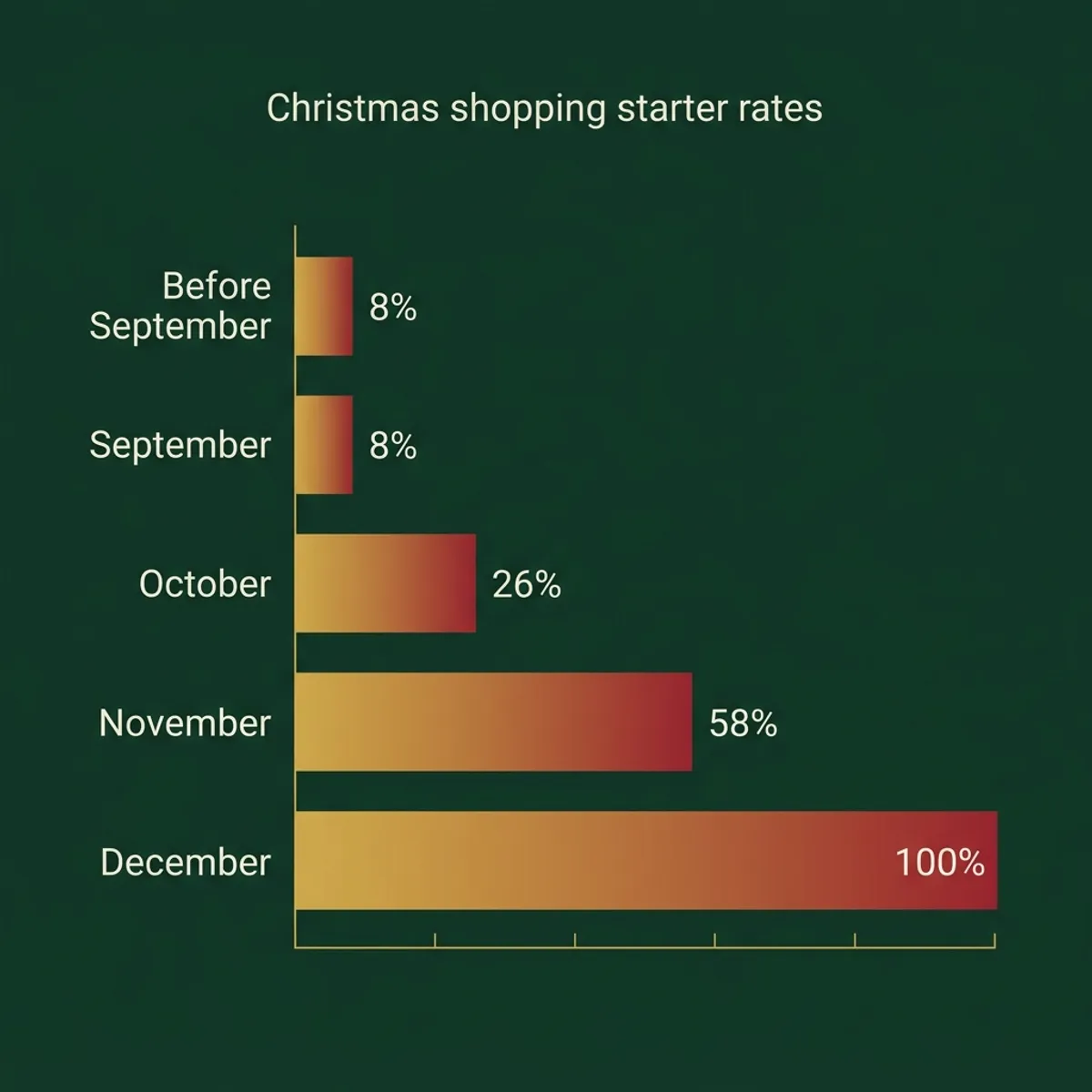
| Timing | Share Started | What's Typically Happening |
|---|---|---|
| Before September | ~8.4% | The earliest planners — often budget-conscious shoppers spreading costs across paychecks |
| September | ~7.9% | Early browsing begins; deal-watching starts |
| October | ~25.6% | The largest jump — Halloween shares the spotlight, but holiday retail marketing ramps up hard |
| November (Black Friday/Cyber Monday) | Cumulative 58%+ | The single biggest surge — Black Friday and Cyber Monday convert browsers into buyers |
| December | Remaining ~40%+ | Where the bulk of last purchases happen — 60% expect to finish this month |
Why People Start Early (and Why Some Don't)
The top reasons people shop early are financial, not just organizational. Per NRF's survey, the leading motivations for starting before November are:
- Spreading out the budget (54%)The #1 reason by a clear margin. Managing a large annual expense by breaking it into smaller pieces over multiple paychecks.
- Avoiding last-minute stress (~41%)Avoiding the pressure of final-week store rushes and shipping deadlines.
- Avoiding crowds & shipping bottlenecksEnsuring gifts arrive on time without paying expensive rush shipping fees.
On the flip side, plenty of shoppers wait deliberately. Some prefer to shop closer to the date for better deal timing (many of the steepest discounts land in December, not November). Others are simply busy, or find that gift ideas become clearer the closer they get to the holiday.
Are You "Behind" if You Haven't Started Yet?

No — statistically, you're in good company. Even with the "start early" trend growing, the data shows that a majority of shoppers are still shopping well into December. NRF's survey found that 50% of holiday shoppers plan to shop the week leading up to Christmas Day itself, and an estimated 158.9 million people shop on "Super Saturday" — the last Saturday before Christmas.
So if it's early-to-mid December and you haven't finished (or started), you're not an outlier. You're standing in a genuinely large, well-populated group. The "everyone else is already done" feeling is more perception than reality — a lot of shopping happens compressed into the final two to three weeks, every single year, for millions of people.
The Key Shopping Dates Everyone Converges On
Even with shopping spread across four-plus months, a few specific dates consistently pull in the largest crowds:
| Date | What Happens | Participation Scale |
|---|---|---|
| Black Friday | The single largest in-store shopping day | 80.3M in-store shoppers |
| Cyber Monday | The largest online-only shopping day | 75.9M online shoppers |
| Super Saturday | Final major push (last Saturday before Christmas) | 158.9M shoppers |
| Christmas Week | Last-minute purchases, gift cards, local pickup | ~50% of shoppers still buying |
What the Data Means for Your Own Planning
The data suggests a genuinely balanced approach works better than either extreme. Starting everything in August isn't necessary — the majority of dollars still move in November and December regardless. But waiting entirely until Christmas week means competing with roughly half the country for the same shipping windows and store shelves.
A reasonable middle path, grounded in what the data shows actually happens:
- If budget is your main concern: start earlier (September–October), matching the 54% of early shoppers who cite budget-spreading as their top reason.
- If you just haven't gotten to it yet: December is genuinely normal — 60% of shoppers expect to finish that month too.
- Either way, the final two to three weeks are always the busiest — so if you can get ahead of that specific crunch, even by a little, you'll have an easier time than the roughly half of shoppers converging on the same final week.
For a concrete week-by-week framework (not just data, but an actual plan), see our Weeks Until Christmas planning guide — it maps these exact patterns into a practical checklist.
Frequently Asked Questions
When do most people start Christmas shopping?
About 42% of shoppers start before November, and 58% have started by early November, according to NRF's 2025 survey. However, most of the actual spending still happens in November and December.
Is it too early to start Christmas shopping in October?
No. Roughly 25.6% of shoppers begin in October specifically, making it one of the most common starting months — right as holiday marketing ramps up alongside Halloween.
What percentage of people wait until December to shop?
A significant share — 60% of shoppers expect to finish their shopping in December, and 50% plan to shop the week leading up to Christmas Day itself.
How much do Americans spend on Christmas gifts on average?
NRF's 2025 survey found an average of $890.49 per person on gifts, food, decorations, and other holiday items — the second-highest figure in the survey's 23-year history.
Why do people start shopping early?
The top reason (54%) is spreading out the budget across more paychecks. The second most common reason (around 41%) is avoiding the stress of last-minute shopping.
What's the busiest shopping day before Christmas?
"Super Saturday" — the last Saturday before Christmas — is typically the single busiest remaining shopping day, with an estimated 158.9 million shoppers in 2025.
The Data Says: There's No Single "Right" Time
Whether you're the type who has gifts wrapped by Halloween or the type still browsing on December 23rd, the real national data says you're not alone either way. Christmas shopping in America isn't a single moment — it's a months-long process that roughly half the country spreads out for budget reasons, and roughly half compresses into the final few weeks, often for perfectly good reasons of their own.
If there's one genuinely useful takeaway from the numbers, it's this: the final two to three weeks before Christmas are always the most crowded, both in stores and in shipping queues. Getting even a little ahead of that specific window — not necessarily starting in August — is where the real advantage lives.
Clara Sterling
Holiday Editor & HistorianClara Sterling is a cultural historian and lifestyle writer specializing in Christmas traditions, holiday folklore, and winter solstice celebrations.