
Christmas Traditions Around the World
The real stories behind global holiday customs — organized by food, gift-givers, sacred dates, and anticipation.
Ask an American what Christmas looks like and you'll hear about trees, stockings, and Santa sliding down a chimney. Ask a family in Reykjavik, and you'll hear about thirteen mischievous Yule Lads. Ask someone in Caracas, and they'll tell you about roller-skating to church at dawn. Same holiday, same date — wildly different traditions.
What's easy to miss in most "Christmas around the world" lists is why it all diverged so much. It's not random. Every culture folded Christmas into customs that were already there — old winter festivals, local saints, regional folklore — and the result is a holiday that looks genuinely different depending on where you're standing. Here's a real tour through some of the most fascinating traditions, organized not by country, but by what they actually celebrate: food, gift-givers, sacred dates, and the long, anticipatory build-up that makes December feel like December.
For a complete overview of the origin and evolution of the holiday itself, read our main pillar guide on the history of Christmas, learn about the seasonal preparation period in our guide on what Advent is, or discover why we use holly and mistletoe during the holidays.
Regional Snapshots
Las Posadas
Nine nights of celebrations (Dec 16–24) re-enacting Mary and Joseph's search for lodging, filled with songs, piñatas, and gatherings.
Julkalender
A daily televised advent series broadcast every December since 1960. Families gather each morning to watch the story unfold.
The '-ber Months'
The longest countdown on Earth. Celebrations and holiday music start playing as early as September 1, lasting almost four months.
Why Christmas Traditions Vary So Much From Country to Country
Christmas traditions differ so widely because the holiday absorbed local customs wherever it spread — pre-Christian winter festivals, regional patron saints, and centuries of migration all left their mark. When Christianity spread across Europe, it didn't erase existing midwinter celebrations; it folded them in. Scandinavian Yule customs, Roman midwinter feasting, and Germanic tree-worship traditions all got woven into the Christmas story over centuries.
Later waves of migration carried these blended traditions to new places, where they mixed again with local culture. German immigrants brought the Christmas tree to America and Britain. Spanish colonization brought Three Kings Day gift-giving to Latin America. And in places where Christmas isn't a majority religious holiday at all — like Japan or China — the day still found its own foothold, often through very modern, very local reinvention.
That's the real story behind "Christmas traditions around the world": not a single holiday celebrated the same way everywhere, but a family of related customs, each shaped by centuries of local history layered on top of a shared date.
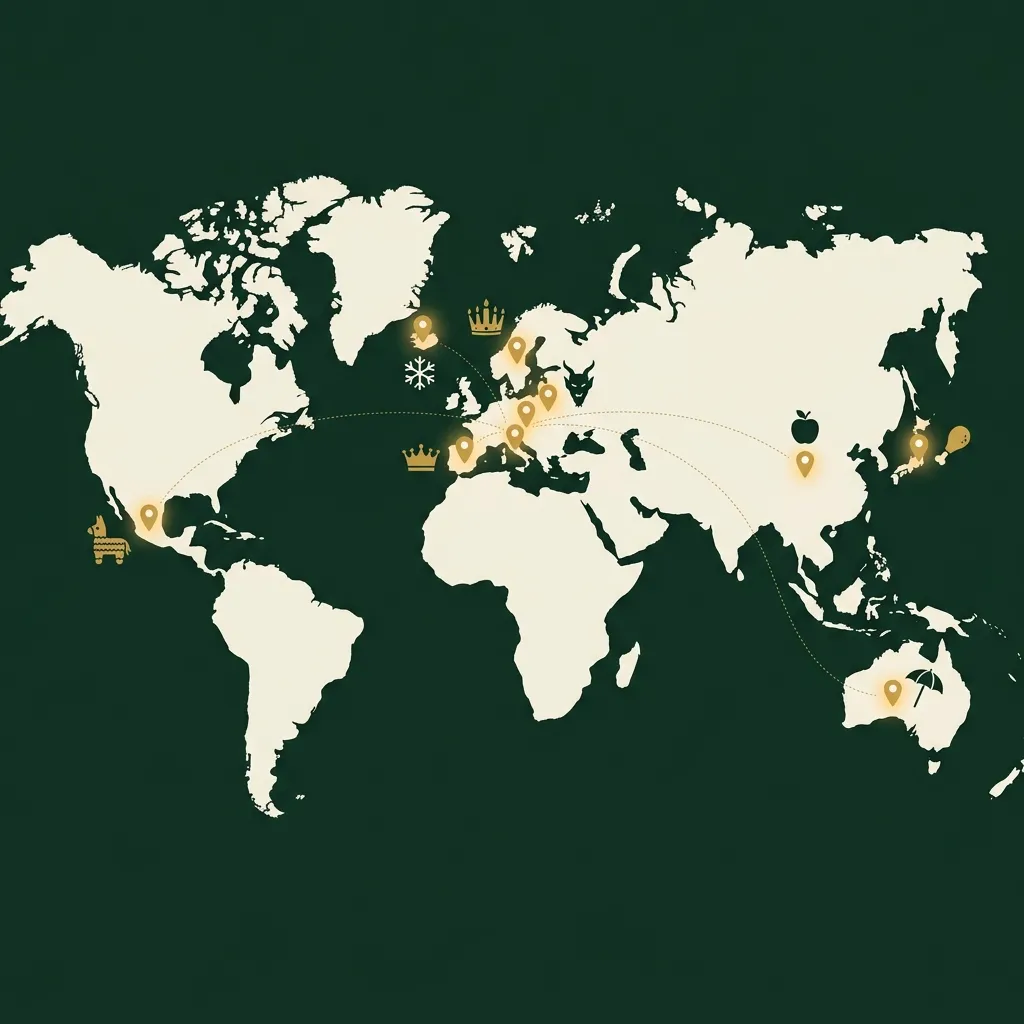
Global map of regional Christmas customs, folklore figures, and holiday food traditions.
Food Traditions Around the World
Feast of the Seven Fishes (Italy & Italian-American)
On Christmas Eve, many Italian and Italian-American families sit down to a seafood feast of seven or more courses. The custom comes from the old Catholic practice of abstaining from meat on the eve of a holy day — so the table fills instead with baccalà (salt cod), calamari, shrimp, and other seafood dishes passed down through generations.
Want the full story, the "why seven," and the dishes families actually serve? Read our complete Feast of the Seven Fishes guide →
KFC Christmas (Japan)
In Japan, where Christmas is a widely celebrated but non-religious holiday, the meal of choice for millions of families is fried chicken from KFC — specifically. This isn't an ancient custom; it traces back to a 1974 marketing campaign called "Kurisumasu ni wa Kentakkii" ("Kentucky for Christmas"). The campaign worked so well it became a genuine annual tradition — families now order their KFC "Christmas dinner" weeks in advance, and December 24 remains the chain's single highest-sales day of the year in Japan.
Apple-Gifting (China)
In China, where Christmas isn't a national holiday, a small but charming custom has emerged around Christmas Eve: gifting apples, often wrapped elaborately in colorful cellophane. The tradition is built on wordplay — the Chinese word for apple, píngguǒ, sounds similar to píng'ān yè, the term for Christmas Eve ("peaceful night"). Giving an apple has become a way of wishing someone a peaceful holiday.
Gift-Giving Figures Around the World
La Befana (Italy)
In Italy, Santa Claus shares the spotlight with La Befana, a kindly witch who flies on a broomstick delivering gifts to children on the eve of Epiphany (January 5th, ahead of January 6th). According to legend, the Three Wise Men invited her to join their journey to see the newborn Jesus; she declined, then regretted it and has been searching for the manger — and leaving gifts for children along the way — ever since.
Krampus (Austria & Bavaria)
Where St. Nicholas rewards good behavior, Krampus handles the opposite. This horned, fur-covered companion of St. Nicholas is said to punish misbehaving children with switches and chains, appearing in early December alongside the saint's more benevolent visit. Krampus parades ("Krampuslauf") are a genuine, popular part of the Austrian and Bavarian holiday season.
The Yule Lads (Iceland)
Iceland doesn't have one Santa — it has thirteen. The Yule Lads (Jólasveinar) visit one by one over the thirteen nights leading up to Christmas, each with their own mischievous personality. Children leave a shoe on the windowsill each night; well-behaved kids find small gifts, while the less well-behaved find a rotten potato.
Santa's Many Names
The figure Americans call Santa Claus has regional cousins everywhere: Sinterklaas in the Netherlands (the direct namesake origin of "Santa Claus"), Père Noël in France, Father Christmas in Britain, and Ded Moroz ("Grandfather Frost") in Russia, who traditionally arrives on New Year's rather than Christmas.
Traditions Tied to Specific Dates
St. Lucia Day (Sweden) — December 13
Before dawn on December 13th, the oldest daughter in many Swedish families rises early, dresses in a white gown with a red sash, and wears a crown of candles to become "Lussi" for the day. She wakes the household and serves saffron buns (lussekatter) by candlelight — a custom rooted in the old Julian-calendar winter solstice, now celebrated as the feast of St. Lucia.
St. Nicholas Day (Germany & the Netherlands) — December 6
Long before December 25th arrives, children in Germany and the Netherlands celebrate St. Nicholas Day on December 6th — leaving out a shoe or boot the night before, hoping to find it filled with small gifts and treats by morning. It's a separate tradition from Christmas Day gift-giving, and for many families, the true kickoff of the season.
Epiphany / Three Kings Day (Spain & Latin America) — January 6
In Spain and much of Latin America, the main gift-giving day isn't December 25th at all — it's January 6th, Epiphany, commemorating the visit of the Three Wise Men (Los Reyes Magos) to the infant Jesus. Children leave out shoes and treats for the Kings' camels the night before, and the holiday season stretches a full two weeks longer than in the US.
Traditions of Anticipation and Preparation
Las Posadas (Mexico)
For nine nights beginning December 16th, Mexican communities re-enact Mary and Joseph's search for lodging in Bethlehem. Each night, a procession moves from house to house, singing and asking for shelter, before being welcomed in for food, songs, and often a piñata. The nine nights represent the nine months of pregnancy, ending on Christmas Eve.
The First Star Custom (Poland & Ukraine)
In Polish and Ukrainian households, Christmas Eve dinner (Wigilia in Poland) doesn't begin until the youngest child spots the first star in the evening sky — a nod to the Star of Bethlehem. Once it's spotted, the meatless, multi-course meal can finally begin.
Advent Calendars and Wreaths (Germany)
The modern Advent calendar — one door opened per day counting down to Christmas — originated in 19th-century Germany, evolving from chalk marks on doors into the printed and chocolate-filled calendars sold worldwide today. The Advent wreath, with one candle lit per Sunday of Advent, comes from the same German Lutheran tradition.
Christmas in the Southern Hemisphere
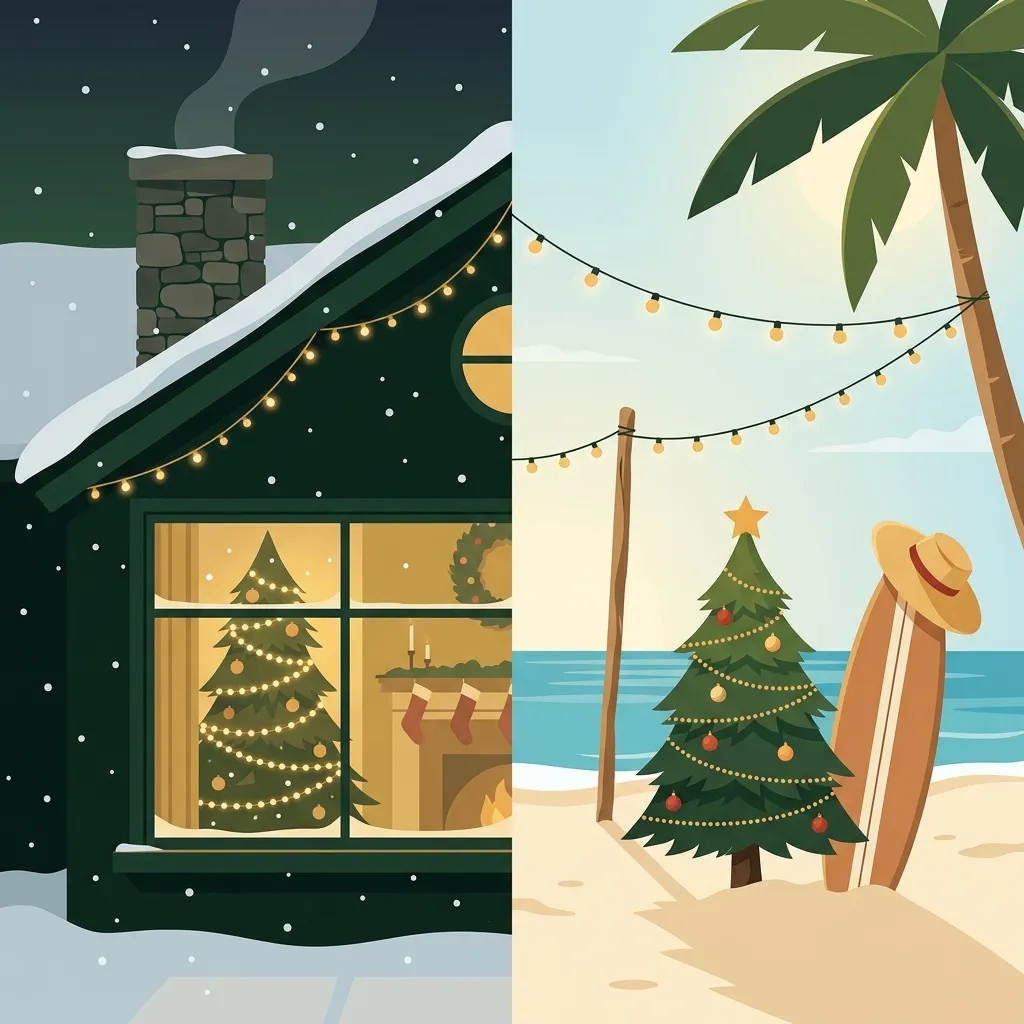
Opposite seasons, shared celebration: Northern snowy winter Christmas vs. Southern Hemisphere beach summer Christmas.
In the Southern Hemisphere, Christmas falls in the middle of summer — which turns a lot of "classic" imagery upside down. In Australia, New Zealand, and South Africa, December 25th means beach barbecues, outdoor "Carols by Candlelight" events, and — in Australia especially — Santa sometimes depicted in boardshorts or arriving by surfboard rather than a sleigh.
The food shifts too: instead of a heavy roast dinner, many Australian and South African Christmas tables feature seafood, cold ham, and pavlova (a meringue-based dessert) — built for a hot afternoon, not a snowy evening. It's a genuinely disorienting scene for anyone used to the Northern Hemisphere's snow-and-fireplace version of the holiday, and a good reminder that "traditional Christmas" always depends on where you're standing.
Frequently Asked Questions
Why does Japan eat KFC for Christmas?
It began with a 1974 marketing campaign by KFC Japan ("Kentucky for Christmas"). Because Christmas isn't a traditional holiday in Japan, the campaign filled a cultural gap and became a genuine annual custom — December 24th remains KFC Japan's busiest sales day of the year.
What is Krampus?
Krampus is a horned, folklore companion of St. Nicholas in Austrian and Bavarian tradition. While St. Nicholas rewards good children, Krampus is said to punish misbehaving ones, appearing in early December alongside the saint's visit.
What is La Befana?
La Befana is a gift-giving witch in Italian folklore who delivers presents to children on the eve of Epiphany (January 5th), based on a legend that she declined to join the Three Wise Men's journey and has been searching for the Christ child ever since.
Is Christmas celebrated in summer anywhere?
Yes — in the Southern Hemisphere (Australia, New Zealand, South Africa, and parts of South America), Christmas falls during summer, leading to beach-based and outdoor celebrations instead of the snowy imagery common in the Northern Hemisphere.
What is the Feast of the Seven Fishes?
An Italian and Italian-American Christmas Eve tradition featuring seven or more seafood dishes, rooted in the Catholic custom of abstaining from meat before a holy day. Read the full guide →
Why do some countries open presents on January 6th instead of December 25th?
In Spain and much of Latin America, gift-giving centers on Epiphany (January 6th), which commemorates the Three Wise Men's visit to the infant Jesus — a separate tradition from the Christmas Day celebrations more common in the US and UK.
Explore More Traditions
This is just the beginning. Christmas traditions run deep enough to fill entire books, and we're building out dedicated guides to the ones worth knowing in real detail:
The full story, origins, and 7 traditional seafood courses served on Christmas Eve.
Deep-dive guides on Las Posadas, Wigilia, and the history of Krampus in development.
One Holiday, a Thousand Ways to Celebrate It
What ties all of this together isn't the tree, or the food, or even the date — it's the shared instinct to gather, to mark the darkest part of the year with light, warmth, and generosity, in whatever form a culture has built over centuries to do that. Whether that means seven fish courses, thirteen mischievous elves, a witch on a broomstick, or a barbecue on the beach, it's all the same impulse wearing very different clothes.
The next time someone tells you "the real way to celebrate Christmas," you'll know there isn't just one — there are hundreds, each one earned through its own long, particular history.
Clara Sterling
Holiday Editor & HistorianClara Sterling is a cultural historian and lifestyle writer specializing in Christmas traditions, holiday folklore, and winter solstice celebrations.