
Why Do We Use Holly and Mistletoe at Christmas? Origins & Meaning
Explore the history, folklore, Christian/pagan symbolism, and the nineteenth-century customs behind two of Christmas's most iconic plants.
Christmas decorations can seem ordinary until you stop and ask where they came from. A green branch of holly, a wreath on the door, or a sprig of mistletoe can carry centuries of history. But the story is not as simple as saying these plants were "invented" as Christmas decorations.
Holly and mistletoe became associated with Christmas through a mixture of ancient winter customs, European folklore, Christian symbolism, and traditions that developed much later. Their meanings also changed over time.
Holly and mistletoe are used at Christmas because both plants became associated with winter traditions, life, protection, love and later Christian symbolism. Holly's evergreen leaves and red berries made it a popular winter decoration, while mistletoe became famous for its association with love and kissing.

Traditional Christmas decorations featuring a green holly wreath with red berries on the door and mistletoe suspended above.
What Are Holly and Mistletoe?
Holly and mistletoe are both plants associated with winter, but they are botanically very different. Below is a side-by-side comparison to resolve common confusions:
| Feature | Holly | Mistletoe |
|---|---|---|
| Common Appearance | Glossy spiky green leaves with red berries | Smooth green leaves with pale white berries |
| Plant Type | Evergreen shrub/tree (Ilex) | Parasitic plant growing on host trees (Viscum) |
| Famous Custom | Used in wreaths, garlands, and centerpieces | Hanging above doorways for the kissing tradition |
| Main Symbols | Eternal life, protection, and Christian theology | Love, peace, fertility, and friendship |
| Toxicity Warning | Berries are toxic to humans and pets | All parts are toxic to humans and pets |
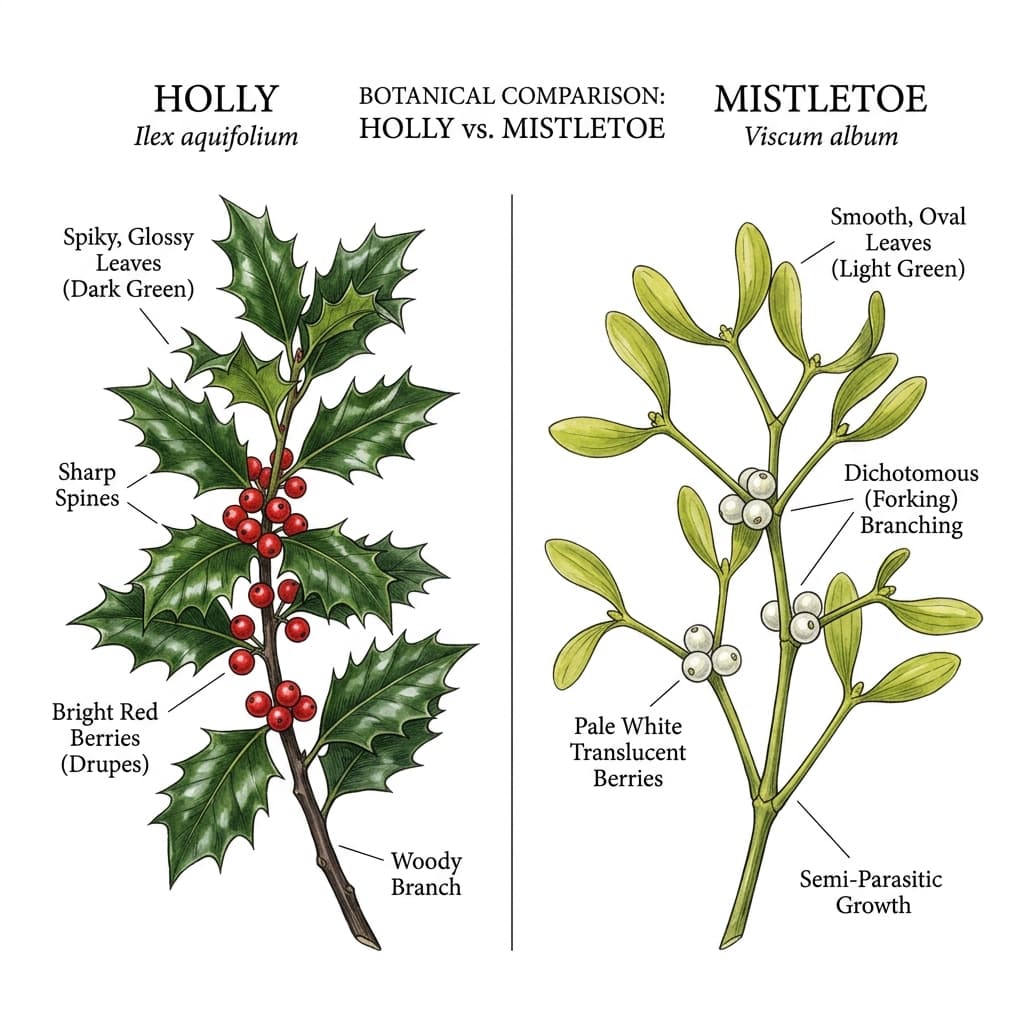
Comparison showing the distinct dark-green spiky leaves and red berries of holly alongside the smooth green leaves and white berries of mistletoe.
Why Is Holly Used at Christmas?
Holly is used at Christmas largely because it remains green during winter and later gained strong religious and cultural symbolism. In a season when many trees lose their leaves, evergreen plants stood out. This made them useful for winter decoration long before modern mass-produced decorations.
Christian Symbolism in Holly
Over time, Christian traditions adopted holly and gave it specific theological meanings:
- Spiky Leaves: Traditionally associated with Jesus' crown of thorns worn during the Passion.
- Red Berries: Symbolic of the drops of blood Christ shed on the cross.
- Evergreen Nature: Symbolizes eternal life and resurrection through Christ.
Why Is Mistletoe Used at Christmas?
Mistletoe became associated with Christmas because older European beliefs about the plant's unusual winter growth, fertility, and protection eventually became connected with holiday decoration and kissing customs.
Mistletoe is a hemi-parasitic plant that grows on host trees. Because it lacks roots in the ground and stays green high up in host tree branches even in winter, ancient Celtic and Norse cultures viewed it as a plant of magical vitality.
Why Do We Kiss Under Mistletoe?
The custom of kissing under mistletoe is a famous Christmas tradition that blends Norse mythology with British culture.
The Norse Myth of Baldur and Frigg
In Norse mythology, the god Baldur was protected from all threats on Earth except mistletoe, which his mother Frigg had overlooked. The trickster Loki crafted a weapon from mistletoe that killed Baldur. In some versions of the myth, Frigg's tears became the white berries, and she declared mistletoe a symbol of love, promising that anyone standing beneath it would receive a kiss of peace.
Eighteenth-Century Britain
While the Norse myth is ancient, the actual custom of kissing under the mistletoe at Christmas developed much later. It became established in England during the 18th century—initially among household servants—and was popularized globally by nineteenth-century Victorian Christmas culture. Writers like Washington Irving and Charles Dickens described the custom, sealing its place in holiday tradition.
How Christmas Greenery Evolved
Trace the evolution of holly and mistletoe from ancient seasonal markers to modern global decorations:
Evergreen Winter Symbology
Various winter cultures value evergreen plants as symbols of life during cold months when other plants lay dormant.
Saturnalia Associations
Romans decorate homes and exchange evergreen twigs, including holly, during midwinter festivals.
Household & Church Greenery
Historical church wardens buy holly and ivy to decorate churches and community spaces before Christmas.
Baldur and Mistletoe Legends
Legends connect mistletoe with Baldur, Frigg, and themes of protection, fertility, and peace.
Origin of Kissing Under Mistletoe
The modern Christmas kissing tradition becomes established in Britain, primarily among household servants, before spreading.
Popularization & Literature
Writers like Washington Irving and Charles Dickens document and popularize holly and mistletoe as essential Christmas decor.
Global Christmas Symbols
Holly and mistletoe are recognized globally as classic symbols of Christmas color, decoration, and festive romance.
Are Holly and Mistletoe Poisonous?
Yes. If you choose to decorate with real plants, safety must be a priority. Both holly and mistletoe contain toxic compounds.
- Holly Berries: Contain saponins and other compounds that cause stomach irritation, vomiting, and nausea in humans and pets if ingested.
- Mistletoe: All parts, especially the leaves and white berries, contain viscotoxins. Ingestion can cause severe abdominal pain, low blood pressure, and respiratory distress.
- Safe Decorating: Keep real boughs out of reach of children and pets, or opt for high-quality artificial replicas for safety.
Part of a Broader Christmas Legacy
The use of evergreen plants is just one aspect of how winter customs evolved. To learn more about how other iconic practices developed, read our guide on the history of the Christmas tree or trace the origins of holiday customs in our guide to Christmas traditions around the world.
To understand the chronological build-up of these customs, you can also read about the four-week preparatory season in our guide explaining what Advent is.
Frequently Asked Questions About Christmas Greenery
Quick answers regarding the history, safety, and customs of holly and mistletoe:
Why do we use holly at Christmas?
Holly is used because it remains green during winter and has long-standing cultural and Christian symbolism. Its red berries and green leaves also made it a natural decoration.
Why do we use mistletoe at Christmas?
Mistletoe became a Christmas decoration through older European folklore and later holiday customs involving love, fertility, peace, and kissing.
Why do people kiss under mistletoe?
The kissing custom developed in Britain and became established as a Christmas tradition during the 18th and 19th centuries. Several theories exist about its earlier origins, including Norse and fertility-related folklore.
Are holly and mistletoe pagan traditions?
Both plants have cultural histories that predate modern Christmas, but calling them simply "pagan Christmas traditions" is too simplistic. Their modern Christmas meanings developed through multiple cultural and Christian influences over centuries.
Conclusion
Holly and mistletoe are Christmas symbols because their stories developed over many centuries. Evergreen plants represented winter life, while folklore gave mistletoe associations with fertility, love, and protection. Christianity later added new meanings to holly and other Christmas greenery.
The most useful way to understand these traditions is not to search for one single "origin." Christmas customs are often layers of history. If you see holly in a wreath or mistletoe above a doorway this Christmas, you are seeing the result of many different traditions that gradually became part of the holiday we know today.
Clara Sterling
Holiday Editor & HistorianClara Sterling is a cultural historian and lifestyle writer specializing in Christmas traditions, holiday folklore, and winter solstice celebrations.