
History of Christmas: Origins, Traditions, and Evolution
Explore the history of Christmas, from pre-Christian solstice customs and the establishment of December 25 to medieval feasts, Puritan bans, and the Victorian creation of modern family traditions.
Christmas feels familiar. Families decorate trees, exchange gifts, listen to holiday music, and gather on December 25. But many of these traditions developed at different times and in different places.
The history of Christmas is therefore not one simple story. It is a long history shaped by Christianity, older winter customs, medieval celebrations, European traditions, Victorian culture, and American life. This guide explains what historians know, what remains debated, and how Christmas became the holiday millions of people recognize today.
The history of Christmas is the story of how a Christian celebration of Jesus' birth developed over many centuries. By the fourth century, December 25 was established as the Christmas date in Rome. Medieval celebrations, European winter customs, Victorian traditions, American culture, and modern media later shaped the Christmas holiday people know today.
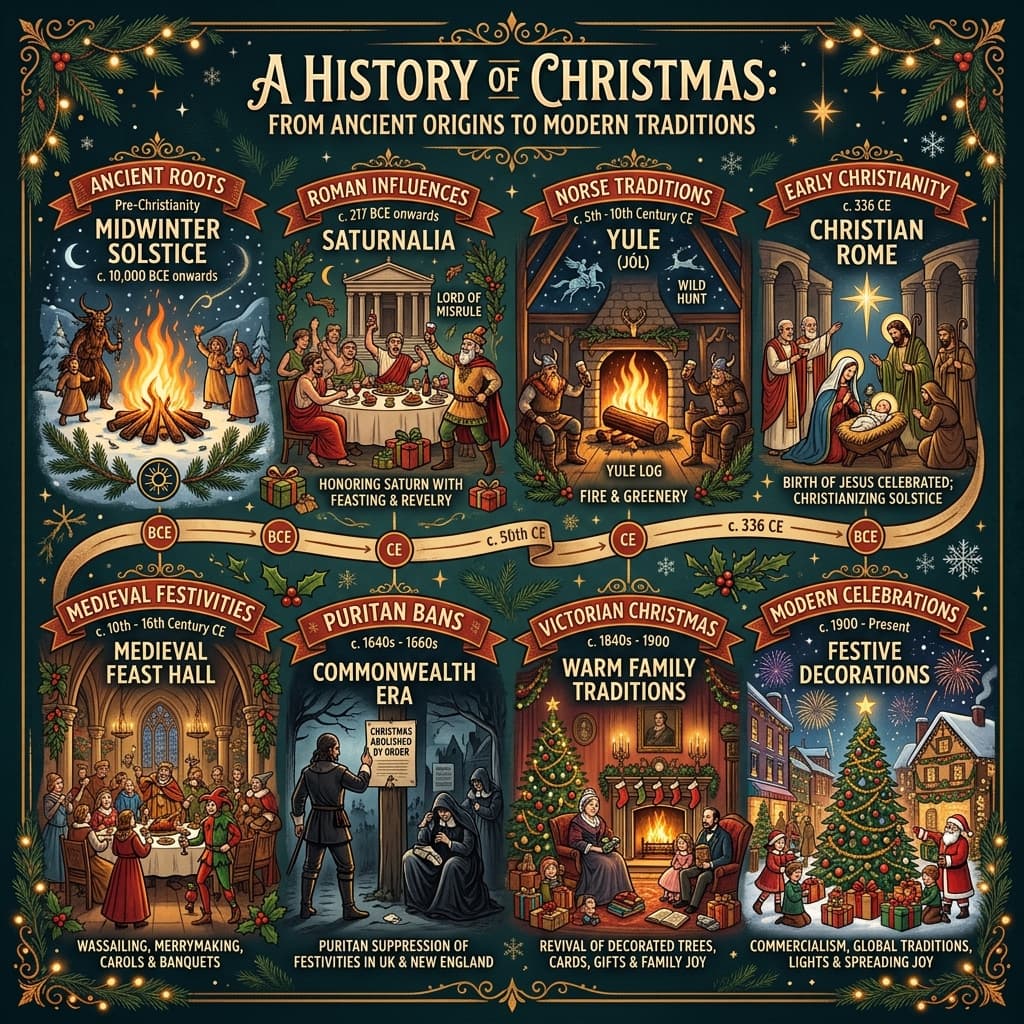
The historical development of Christmas: ancient midwinter Solstice celebrations transitioning into early Christian Rome, medieval public carnivals, Puritan suppression, and the family-centered Victorian era.
What Is the History of Christmas?
Christmas is a Christian festival that celebrates the birth of Jesus Christ, but the modern holiday also includes many cultural and secular traditions.
The holiday developed over many centuries. Winter celebrations existed before Christmas, while Christian communities gradually developed their own celebration of the Nativity. Later, medieval customs, European traditions, Victorian culture, literature, immigration, and American commerce helped shape the Christmas season. For an in-depth exploration of how theology, history, and cultural traditions intersect today, read our pillar guide on what is the meaning of Christmas.
Christmas History at a Glance
| Period | What Changed |
|---|---|
| Before Christianity | Winter festivals and seasonal customs existed (Saturnalia, Yule). |
| Early Christianity | Christians developed traditions and theology around the Nativity. |
| 4th Century | December 25 became established in Rome as Christmas. |
| Middle Ages | Christmas became a major multi-day public celebration (Twelve Days). |
| Reformation | Various church groups challenged, reformed, or banned Christmas. |
| 19th Century | Victorian culture reshaped the holiday, turning it domestic. |
| 19th-Century America | Santa Claus, trees, cards, gift-giving, and family focus grew popular. |
| 1870 | Christmas became an official U.S. federal holiday. |
| 20th Century | Mass media, retail advertising, movies, and music expanded Christmas culture. |
| Today | Christmas is celebrated worldwide as both a religious and cultural holiday. |
The exact timeline is more complicated than a single birth date. Historical evidence shows that Christmas developed gradually rather than appearing fully formed.
How Did Christmas Begin?
Christmas began as a Christian celebration of the birth of Jesus, but the exact date of that birth is not given in the New Testament.
The Gospels describe the Nativity but do not state that Jesus was born on December 25. Historians therefore distinguish between the historical date of Jesus' birth and the later Christian date chosen to celebrate the Nativity.
Early Christianity also placed greater emphasis on Easter than on celebrating Jesus' birthday. Christmas gradually became an established feast, with Rome celebrating it on December 25 by the fourth century.
Why Is Christmas Celebrated on December 25?
December 25 became the traditional date for Christmas, but historians do not have one universally accepted explanation for why.
Two major theories appear repeatedly in historical discussions:
- The Winter-Festival Theory (History of Religions): Suggests that the date was selected in Rome to correspond with existing midwinter Roman celebrations like Saturnalia or the birth of Sol Invictus (the Unconquered Sun) on December 25, facilitating the integration of the new Christian holiday.
- The Calculation Theory (Annunciation Connection): Connects December 25 with an early Christian calculation of March 25 as the date of Jesus' conception (the Annunciation) and crucifixion. Counting exactly nine months of gestation leads directly to December 25.
For a detailed look at the historical calculations and dates, you can read our guide on why Christmas is celebrated on December 25.
Was Jesus Actually Born on December 25?
We do not know. The Bible does not provide an exact birth date for Jesus. December 25 is the traditional date used to celebrate his birth, not a date that historians can establish as his actual birthday.
Christmas Before Christianity: Winter Festivals and Seasonal Traditions
Winter celebrations are much older than Christmas. People in different parts of Europe marked the darkest part of the year with food, fires, greenery, music, and gatherings. These traditions did not all have the same meaning, and they should not be treated as one single ancient "Christmas."
Saturnalia in Ancient Rome
Saturnalia was a Roman festival honoring Saturn, the god of agriculture, held in mid-December. It included feasting, gambling, gift-giving, and temporary changes to normal social behavior (such as masters serving their slaves). It was a major Roman winter festival that had existed long before the Christian Christmas celebration.
Yule and Northern European Winter Traditions
Yule was associated with winter celebrations among Germanic and Norse peoples. Traditions like burning the Yule log, decorating with winter greenery (mistletoe, ivy, and holly), and seasonal feasting eventually became part of a broader European Christmas tradition over time.
What We Can and Cannot Prove About Pagan Influences
This is where Christmas history requires care. Some customs associated with Christmas clearly have older seasonal parallels. But that does not prove that every Christmas tradition was directly copied from a specific pagan festival.
The safest historical conclusion is this: Christmas developed in a cultural environment that already contained winter festivals and customs, and some traditions later became associated with Christmas. The exact relationship between individual traditions is different from one custom to another.
The First Christmas Celebrations and the Middle Ages
Early Christmas was not identical to the modern holiday. As Christianity developed, communities created celebrations around the Nativity. Church services became an important part of the feast, while food, music, storytelling, and community celebrations developed around it.
By the medieval period, Christmas had become much larger and more socially important. It was celebrated across the traditional Twelve Days of Christmas (from Christmas Day, December 25, through Epiphany in early January).
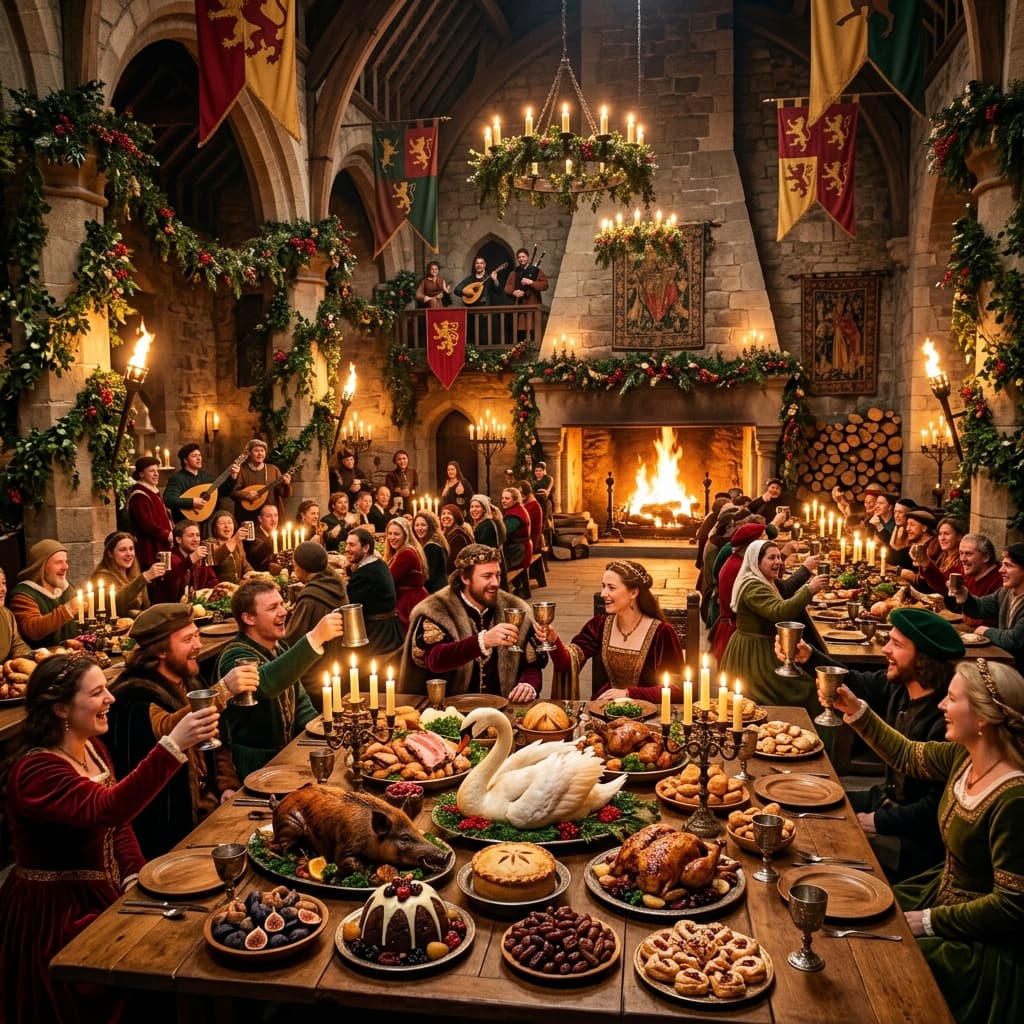
A rendering of a medieval Christmas feast in a grand castle hall, featuring large tables of food, candles, and winter greenery.
Medieval Christmas Food and Feasting
Food was central to medieval Christmas. Wealthier households could serve large quantities of meat (such as boar heads, geese, and venison), seafood, fruit, nuts, cakes, and spiced drinks. Early forms of Christmas pudding (known as frumenty) began to emerge during this period.
Christmas Games, Music, and Pageants
Christmas was also a time for public entertainment. Celebrations included music, singing early carols, playing theatrical miracle plays, pageants, public dancing, and games.
Why Christmas Was Once Banned
Christmas has not always been universally accepted. Religious reformers in parts of Europe objected to Christmas celebrations that they considered excessive, disorderly, or insufficiently biblical.
Puritans and the English Christmas Ban
In England, Puritan leaders objected to traditional Christmas festivities because they involved heavy drinking, rowdy games, public disorder, and had no clear mandate in the Bible. In the 1640s, during the English Civil War, the Parliament officially cancelled Christmas celebrations. Shops were ordered to stay open, and church services were banned. After the monarchy was restored in 1660, Christmas celebrations returned to England, though in a slightly muted form.
Christmas in Colonial America
Christmas was also controversial in early America. In Massachusetts, the Puritan government outlawed Christmas celebrations from 1659 to 1681. People who celebrated by feasting, taking off work, or performing holiday rituals were fined five shillings. Other colonial settlements, such as those in Virginia and New York, had different attitudes and kept traditional holiday celebrations alive.
How the Victorian Era Changed Christmas
The Victorian era helped create the Christmas that feels familiar today. The 19th century saw major changes in family life, publishing, transportation, manufacturing, postal services, and children's culture. Christmas became increasingly associated with family, children, gifts, charity, home decoration, and storytelling.
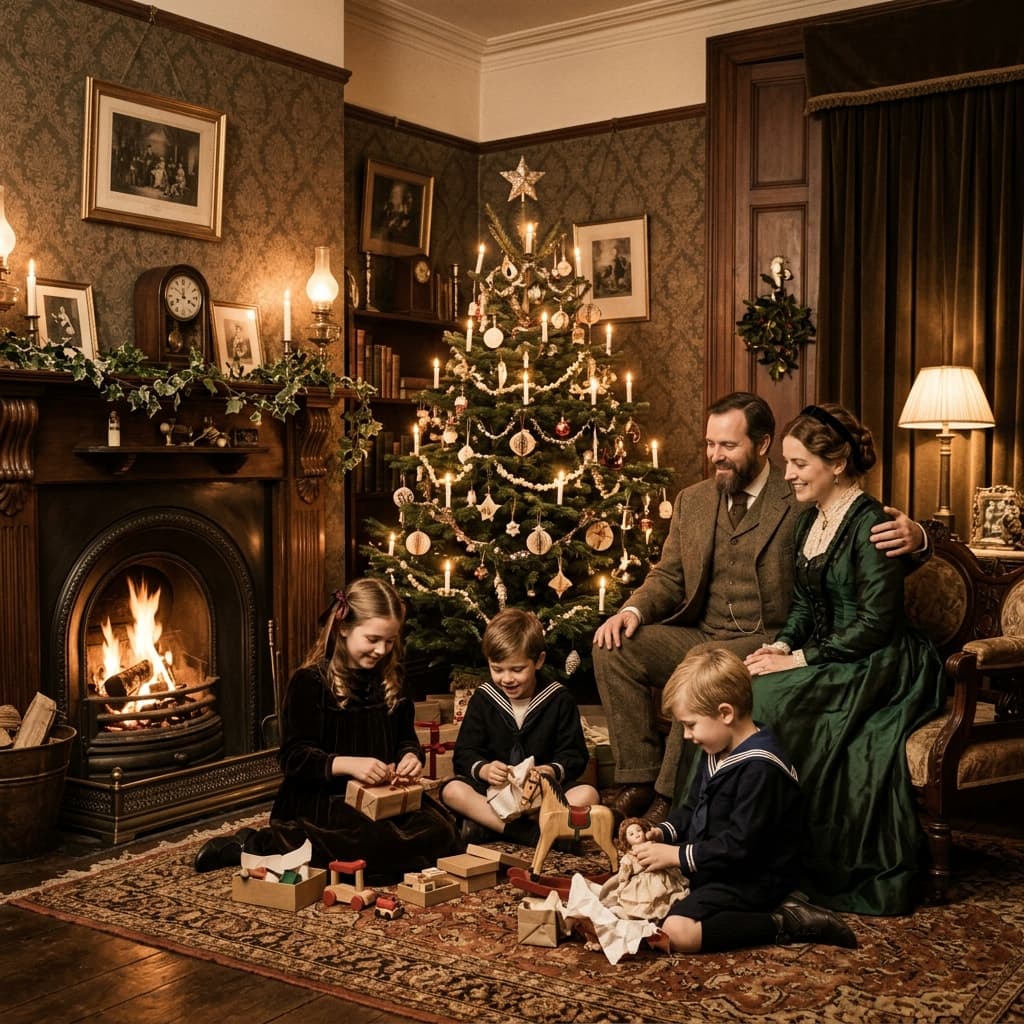
A rendering of a Victorian parlor, showing a family decorating an indoor pine tree with candles and paper flowers.
Queen Victoria and Prince Albert
Prince Albert, born in Germany, helped popularize the decorated Christmas tree in the British royal household. In 1848, a famous drawing of Victoria, Albert, and their children around a decorated Christmas tree at Windsor Castle was published. This engraving sparked a massive public fashion. For the full history of the tree, see our history of the Christmas tree guide.
Charles Dickens and A Christmas Carol
Charles Dickens' A Christmas Carol, published in 1843, became one of the most influential Christmas stories in history. Its themes of charity, family gatherings, generosity, and compassion perfectly matched the changing Victorian idea of the holiday and revived interest in seasonal traditions.
The Rise of Christmas Cards and Gift Giving
The first commercial Christmas card was designed in England in 1843 by Henry Cole. Improved printing technology and cheap postal rates (the Penny Post) made sending card greetings extremely popular. Concurrently, the growth of factory manufacturing turned gift-giving from a minor tradition into a major part of the holiday season, centering it around children.
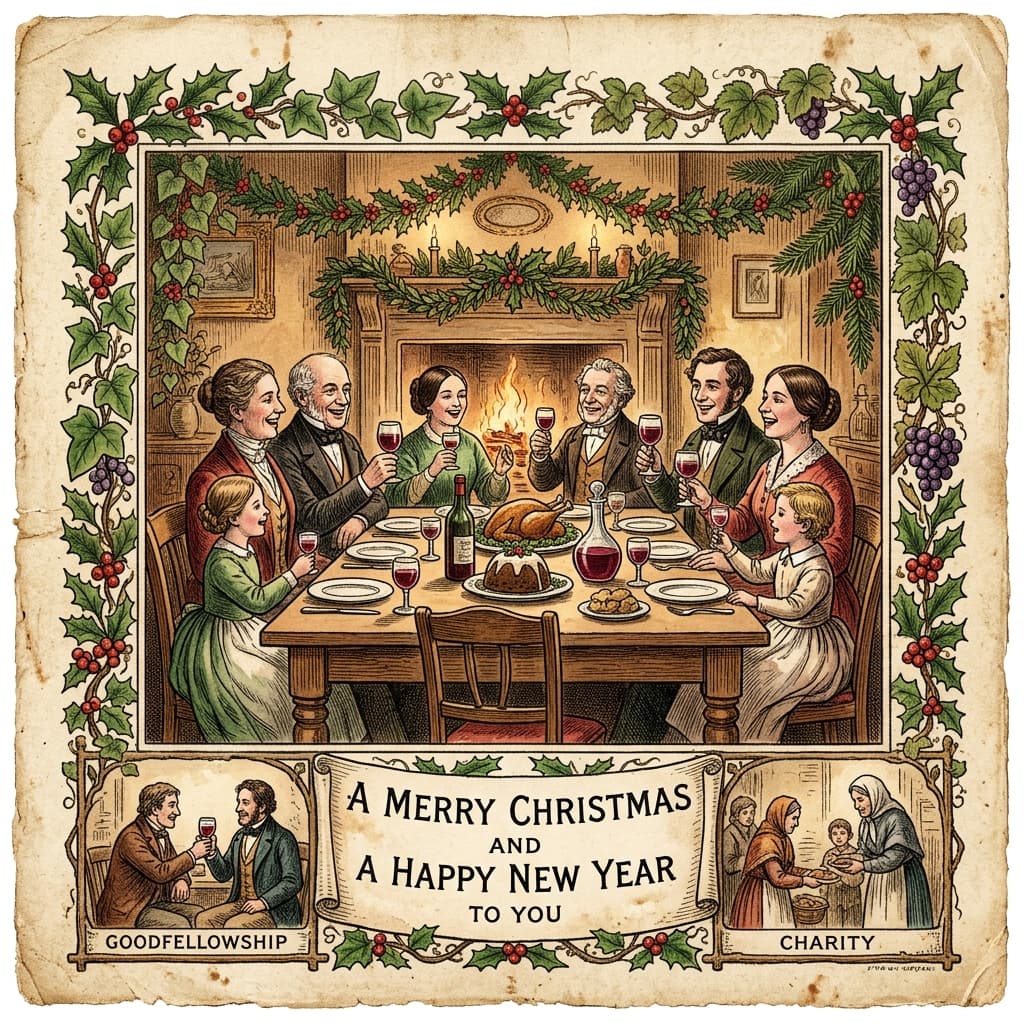
A reproduction of the historical 1843 Victorian Christmas card designed by John Calcott Horsley for Henry Cole.
How Christmas Became Popular in the United States
Christmas developed uniquely in the United States. Immigrants from different European countries brought their regional customs, which mixed with American literature, commerce, and advertising to form a more uniform national celebration.
Key American milestones include:
- Post-Civil War Unity: Christmas became an important holiday for healing and family comfort following the American Civil War.
- Federal Holiday Status (1870): Christmas was officially declared a U.S. federal holiday on June 26, 1870.
- The Melting Pot of Traditions: The American Christmas absorbed German trees, Dutch Santa Claus figures, English carols, and Irish candle lighting customs.
How Santa Claus Became Part of Christmas
Santa Claus has a long and complicated history. The modern character developed from several distinct traditions:
- Saint Nicholas: A 4th-century Christian bishop in Myra (modern Turkey) renowned for secret gift-giving.
- Sinterklaas: The Dutch feast-day figure of Saint Nicholas, who arrived in American culture via Dutch settlements in New York.
- American Literature: Clement Clarke Moore's 1823 poem "A Visit from St. Nicholas" (The Night Before Christmas) introduced the sleigh, eight reindeer, and chimney delivery.
- Thomas Nast: The 19th-century cartoonist who drew illustrations standardizing Santa's red suit, North Pole workshop, and lists.
For the complete narrative of Santa Claus, you can read our detailed history of Santa Claus guide.
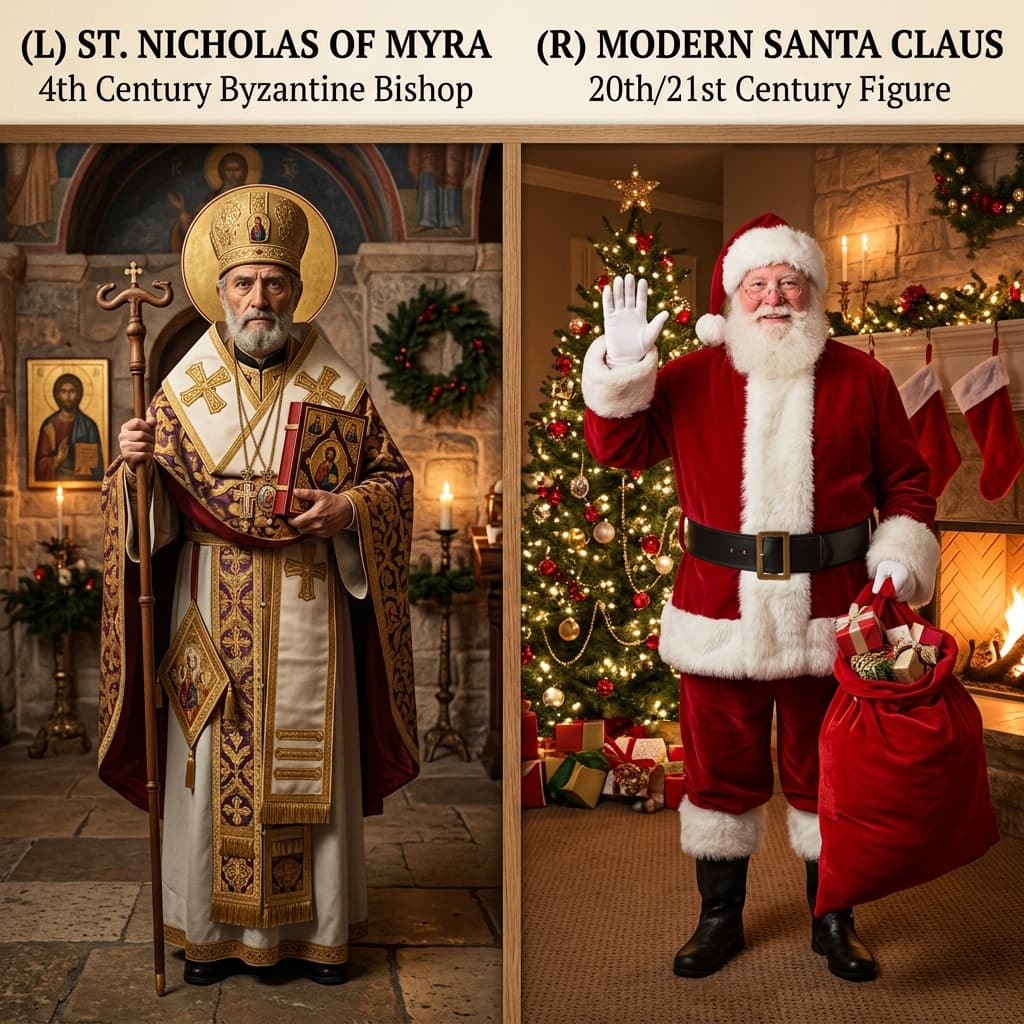
A visual representation showing the transformation of the 4th-century bishop Saint Nicholas into the modern, jolly Santa Claus.
How Christmas Traditions Developed
Many customs that seem essential to Christmas actually developed at different times in history:
Christmas Trees
Developed in German-speaking Europe during the 16th century and popularized globally in the 19th century by Queen Victoria and Prince Albert.
Advent Calendars
Originated in German Lutheran communities during the 19th century as a way to count the days leading to Christmas. Gerhard Lang printed the first commercial calendar in 1908.
Christmas Carols
Medieval religious songs that were sung in communities. The Victorian era saw a massive effort to collect, arrange, and popularize these old carols.
Christmas Stockings
Inspired by the legend of Saint Nicholas throwing bags of gold through a window, landing in stockings hung by the chimney.
To learn about how different cultures celebrate around the globe today, visit our guide to Christmas traditions around the world.
Myths vs. Facts in Christmas History
There is a lot of simplified or inaccurate information about Christmas history circulating online. Here is what historical evidence reveals:
Historical Reality: The relationship is nuanced. Christmas developed as a distinct Christian celebration of the Nativity. While it arose in a culture containing winter festivals and later absorbed some customs, there is no evidence it was a direct 'copy' or simple renaming.
Historical Reality: The Bible does not state a birth date. December 25 was established in the fourth century in Rome as the traditional day to celebrate the Nativity, not as a historically verified birth date.
Historical Reality: From 1659 to 1681, Christmas celebrations were outlawed in Massachusetts, and offenders were fined five shillings.
Historical Reality: Santa's jolly persona, white beard, and red suit were already well-established in 19th-century literature and drawings. Coca-Cola's campaigns standardized and popularized this look globally.
Historical Reality: There are two primary historical theories: the winter-festival theory (aligning with Solstice and Saturnalia) and the calculation theory (counting exactly nine months from March 25, the traditional date of Jesus' conception/crucifixion).
Historical Reality: For centuries, Christmas was a boisterous public carnival featuring rowdy street drinking, begging, and games. The quiet, domestic family holiday was constructed during the Victorian era.
How Christmas Changed in the 20th and 21st Centuries
Christmas continued to evolve after the Victorian era. Radio, newspapers, movies, television, department stores, advertising, music, and later the internet all changed how people experienced Christmas.
From Religious Celebration to Cultural Holiday
Christmas remains a major Christian celebration. At the same time, many people who celebrate Christmas also treat it as a cultural or family holiday. This explains why modern Christmas can include church services, Santa Claus, Christmas trees, family meals, gift exchanges, movies, shopping, charity, music, and decorations.
The Commercialization of Christmas
Commercial Christmas is not entirely a modern invention; the 19th century already saw the growth of Christmas shopping, mass-produced toys, cards, books, and decorations. However, the 20th century accelerated this process through department stores, radio/TV advertising, movies, and branded characters. Christmas became both a major religious season and a major commercial and retail season.
Interactive Timeline: Milestones of Christmas History
Trace the historical development of Christmas through the ages:
Winter Solstice & Early Customs
People across Europe and the Mediterranean marked midwinter Solstice with festivals (Roman Saturnalia, Germanic Yule) symbolizing the return of light.
Spread of Christianity
Early Christian communities spread. The Nativity was not yet widely celebrated, as focus was primarily placed on Easter.
Establishment of December 25
By A.D. 336, Rome documented the first recorded celebration of Christmas on December 25. Pope Julius I later declared it the official date.
The Twelve Days of Christmas
Christmas grew into an extended multi-day public festival featuring feasting, pageants, games, and temporary reversal of social hierarchies.
The Reformation
Protestant Reformation challenged traditional celebrations and saint veneration, altering holiday customs across parts of Europe.
The Puritan Christmas Ban
Puritan rule in England declared traditional Christmas celebrations illegal due to excess, rowdiness, and a lack of scriptural mandate.
Colonial America Suppressions
The Massachusetts Bay Colony banned Christmas celebrations. New England residents could be fined for showing holiday spirit.
Victorian Transformation
The Industrial Revolution, Queen Victoria and Prince Albert, and writers like Charles Dickens reinvented Christmas as a home-centered family holiday.
"A Visit from St. Nicholas"
The publication of the famous poem helped define the imagery of a sleigh, reindeer, stockings, and Christmas Eve chimney deliveries.
Dickens & First Christmas Card
Charles Dickens published 'A Christmas Carol', popularizing generosity and family gatherings. Henry Cole commissioned the first commercial Christmas card.
U.S. Federal Holiday
On June 26, 1870, Christmas was declared a federal holiday in the United States, cementing its place in the national calendar.
Commercialization & Mass Media
Radio, television, advertising, department stores, and standard imagery (like Haddon Sundblom's Coca-Cola Santa) turned Christmas into a global cultural phenomenon.
A Dual Holiday
Christmas exists today as both a deeply spiritual Christian celebration and a widely observed secular cultural holiday.
Frequently Asked Questions About Christmas History
Quick answers to the most common questions about where Christmas traditions originated:
When did Christmas begin?
Christmas developed gradually as a Christian celebration of the birth of Jesus. By the fourth century, December 25 was established as the Christmas date in Rome.
What is the real history of Christmas?
The history of Christmas is a mixture of Christian religious development, older winter customs, medieval celebrations, European traditions, Victorian culture, and modern American influence.
Was Jesus born on December 25?
There is no historical evidence that establishes December 25 as Jesus' actual birthday. The Gospels do not provide an exact date.
Why was Christmas banned?
Some religious reformers believed Christmas celebrations had become too excessive or were not sufficiently supported by Scripture. Puritan authorities suppressed Christmas in parts of England and colonial America.
When did Christmas become a U.S. federal holiday?
Christmas became a federal holiday in the United States on June 26, 1870.
Conclusion
The history of Christmas is a story of change. It began as a Christian celebration of the Nativity and developed within cultures that already had long-standing winter traditions. Over time, medieval customs, European traditions, Victorian literature, American culture, immigration, and modern media helped create today's Christmas.
The most useful way to understand Christmas history is to avoid overly simple explanations. Some traditions have very old roots, some developed much later, and some origins remain debated.
Clara Sterling
Holiday Editor & HistorianClara Sterling is a cultural historian and lifestyle writer specializing in Christmas traditions, holiday folklore, and winter solstice celebrations.