
History of the Christmas Tree: From Ancient Evergreens to Today
Discover the history of the Christmas tree, from pre-Christian evergreens and Central European origins to Queen Victoria, electric lights, and Rockefeller Center.
The Christmas tree feels like one of the oldest parts of Christmas. Every December, millions of families bring a tree into their homes, decorate it with lights and ornaments, and place gifts beneath it. But the story behind that tradition is more complicated than it first appears.
The history of the Christmas tree is not the story of one person inventing a tree for Christmas. Evergreen plants were used in winter traditions long before the modern Christmas tree appeared. The decorated Christmas tree we recognize today developed much later, especially in German-speaking Central Europe, before spreading through Britain, the United States, and eventually around the world.
For a broader understanding of how this iconic custom aligns with other winter solstice and holiday celebrations, view our complete guide on the history of Christmas, discover the significance of the season leading up to it in our guide on what Advent is, or read about the origins of holly and mistletoe.
The modern Christmas tree developed in German-speaking Central Europe during the late medieval and early modern period, especially in the 16th century. Earlier cultures used evergreen plants during winter, but there is no single proven inventor or universally accepted first Christmas tree.
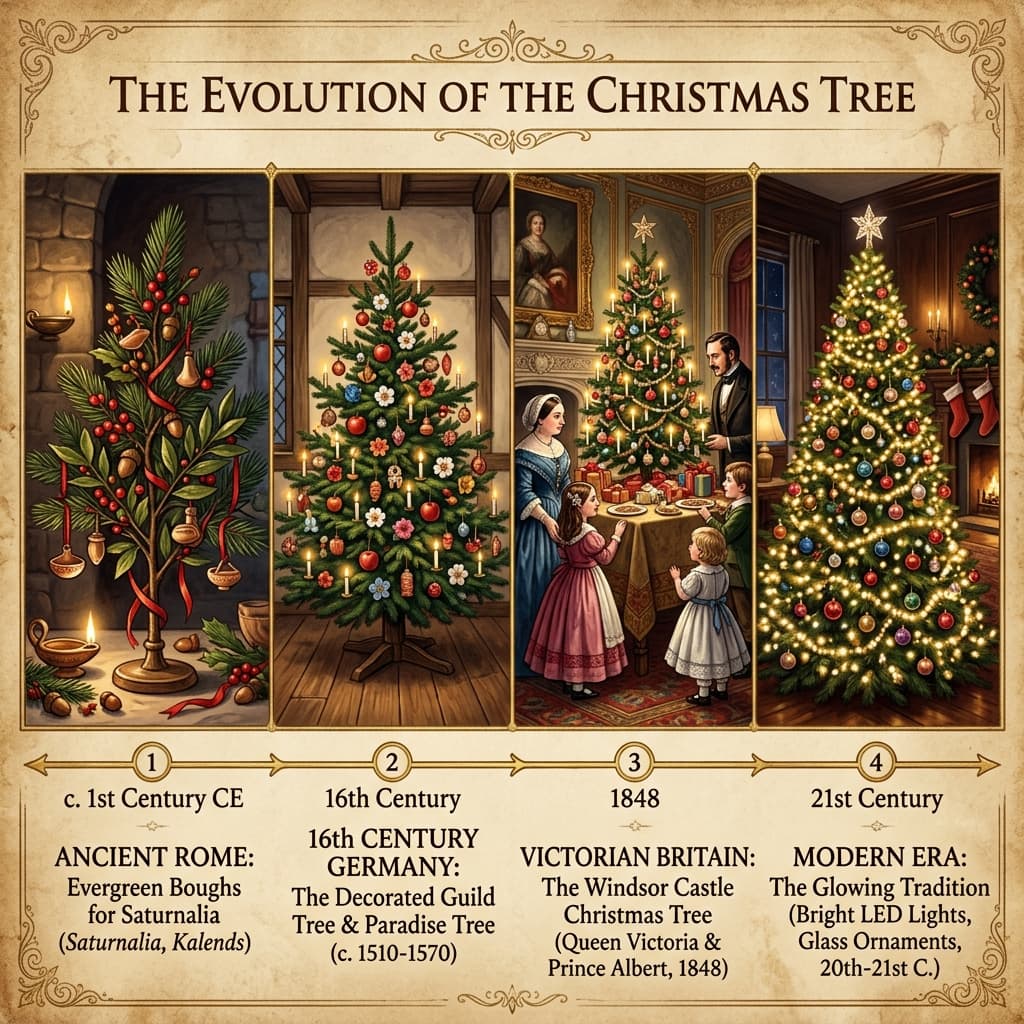
The historical development of the Christmas tree: ancient solstice greenery, 16th-century German decorated trees, Victorian royal popularization, and the electric modern tree.
Where Did the Christmas Tree Originate?
The modern Christmas tree is most strongly associated with German-speaking Central Europe during the 16th century, although its exact starting point is debated.
Several places have claimed to have the first Christmas tree. Riga, Latvia, points to a 1510 event involving a merchant guild. Tallinn, Estonia, has its own claim involving a similar guild tradition. However, historians have questioned whether these events were actually Christmas-tree traditions in the modern sense.
This matters because a decorated tree used for a winter celebration is not automatically the same thing as the Christmas tree that later became common in Christian homes. National Geographic notes that historians have cast doubt on both the Riga and Tallinn claims. Instead, historical evidence points more clearly toward the development of the Christmas tree in the Alsace region during the 16th century.
So there is no universally accepted answer to the question, "Where was the first Christmas tree?" A better answer is that the modern Christmas tree developed in Central Europe, especially German-speaking regions, during the late medieval and early modern period.
Were Evergreens Used Before Christmas Trees?
Yes, many cultures used evergreen plants during winter, but that does not prove that the modern Christmas tree directly came from those practices.
Evergreen plants stay green during the coldest part of the year. Because of this, they naturally became symbols of life, endurance, and the return of spring. Ancient Egyptians used green plants during winter celebrations. Romans used evergreen branches in seasonal decorations, and other European cultures also valued evergreen plants.
But there is an important historical distinction. Using an evergreen branch is not the same as bringing a decorated Christmas tree into a home. The modern Christmas tree has a much more specific history. This distinction is often lost in simplified explanations of Christmas history.
A useful way to understand the history:
Think of the development in three stages:
- Ancient winter evergreen customs (Solstice greenery, Egypt, Rome)
- Medieval and early modern Christian Christmas traditions (Paradise plays)
- The decorated indoor Christmas tree (Germanic, Victorian, and American eras)
The first stage is ancient and universal; the third stage is relatively modern and localized.
What Was the First Christmas Tree?
There is no single universally accepted first Christmas tree. This is one of the most misunderstood parts of Christmas-tree history.
The National Christmas Tree Association lists a 1510 Riga tradition as an early written record. However, National Geographic notes that historians have questioned whether the Riga event and a similar Tallinn event (1441) were actually Christmas-tree traditions. Both occurred in the context of Brotherhood of Blackheads merchant guild celebrations, where a tree was set up in the town square and eventually burned, which is very different from the decorated indoor Christmas tree.
Other evidence points toward the German-speaking world. National Geographic reports that historical records show a Christmas tree at Strasbourg Cathedral in 1539 and notes that the tradition had become established in the surrounding region. There is also evidence for decorated trees in Strasbourg in the early 17th century (1605).
For this reason, historians generally avoid treating one disputed event as the exact moment when the Christmas tree was invented. The Christmas tree does not have one proven inventor or one universally accepted first example. Its modern form developed gradually in Central Europe.
How Christmas Trees Developed in Germany
German-speaking regions played a major role in developing the decorated Christmas tree tradition.
By the 16th century, records describe Christians bringing decorated trees into homes. Some traditions also used wooden pyramid structures decorated with greenery and candles.
One important influence was the medieval Paradise tree. In some Christian communities, December 24 was associated with Adam and Eve. Religious plays about the Garden of Eden used a tree decorated with apples to represent the Tree of Knowledge. Over time, different Christmas customs began to overlap. Evergreen trees, apples, candles, wafers, sweets, and other decorations became part of Christmas celebrations, slowly taking the shape of the modern Christmas tree.
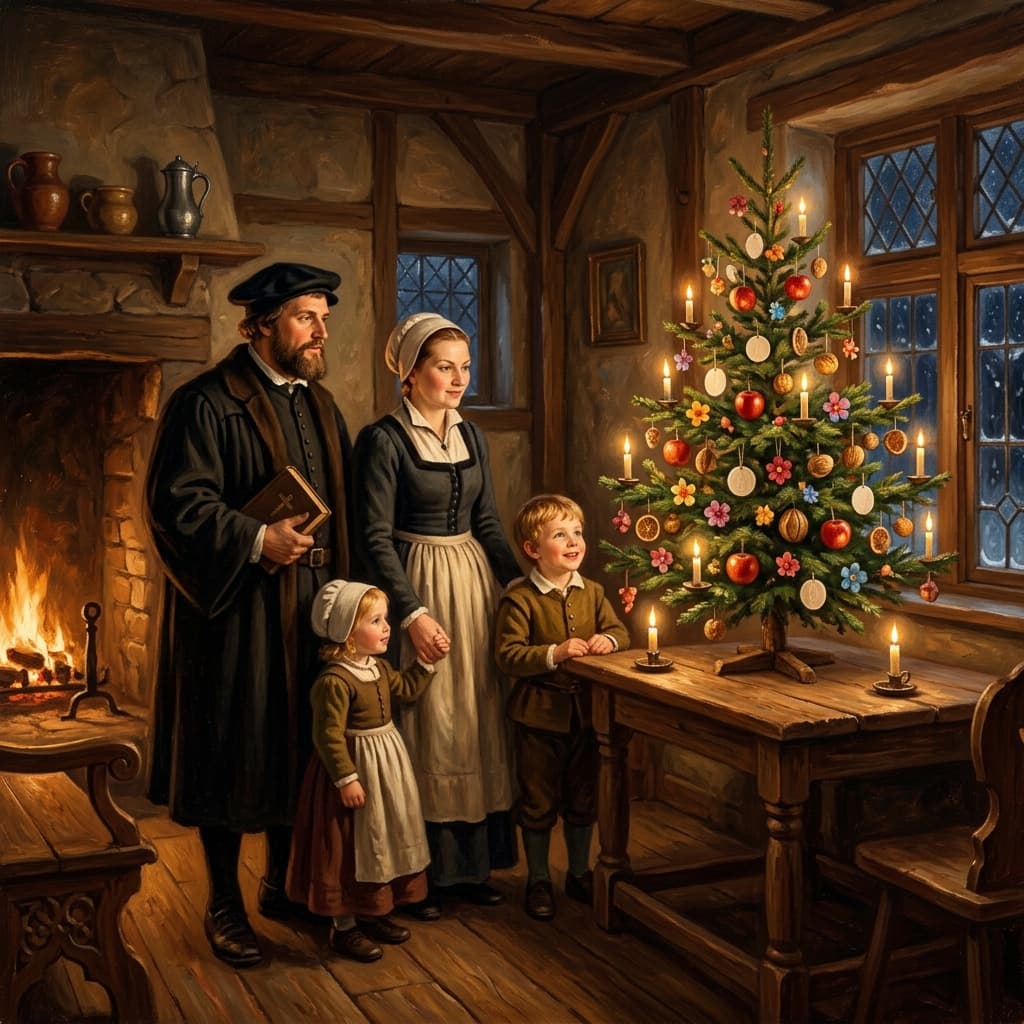
A rendering of a 16th-century German decorated tree, using apples, candles, and paper flowers inside a traditional home.
Did Martin Luther Invent Christmas Tree Lights?
Martin Luther is traditionally credited with adding candles to a Christmas tree, but the story is better treated as a popular tradition than a firmly documented historical fact.
The story says Luther was walking through a forest one winter evening when he saw stars shining through evergreen branches. He supposedly wanted to recreate the scene for his family. According to the story, he brought a tree inside and placed candles on its branches.
It is a beautiful story. But historical writers have long treated it as a legend rather than proven fact. This is an important example of why Christmas history should separate documented evidence from traditional stories.
Candles were the original form of tree lighting in the traditions that developed around decorated Christmas trees. They created a beautiful effect but were also a serious fire hazard, which eventually drove the invention of electric lighting.
How the Christmas Tree Came to Britain
The Christmas tree became popular in Britain during the 19th century after German traditions entered the British royal household.
Queen Charlotte, the German-born wife of King George III, is often credited with introducing a Christmas tree to the British royal household in the late 18th century (specifically in 1800). However, the tradition did not immediately become a mass British custom. That changed during the Victorian period, and the most important figure in making it mainstream was Queen Victoria.
How Queen Victoria Made Christmas Trees Popular
Queen Victoria and Prince Albert helped turn the Christmas tree into a fashionable British tradition.
Prince Albert was German-born and was familiar with Christmas-tree customs from Central Europe. In 1848, the Illustrated London News published an image showing Queen Victoria, Prince Albert, and their children gathered around a decorated Christmas tree.
The image became enormously influential. Victoria was one of the most famous people in the world at the time. What the royal family did became fashionable. The Christmas tree quickly became associated with Victorian family Christmas. The image was later reproduced in the United States, where it helped make the decorated Christmas tree fashionable among American families.
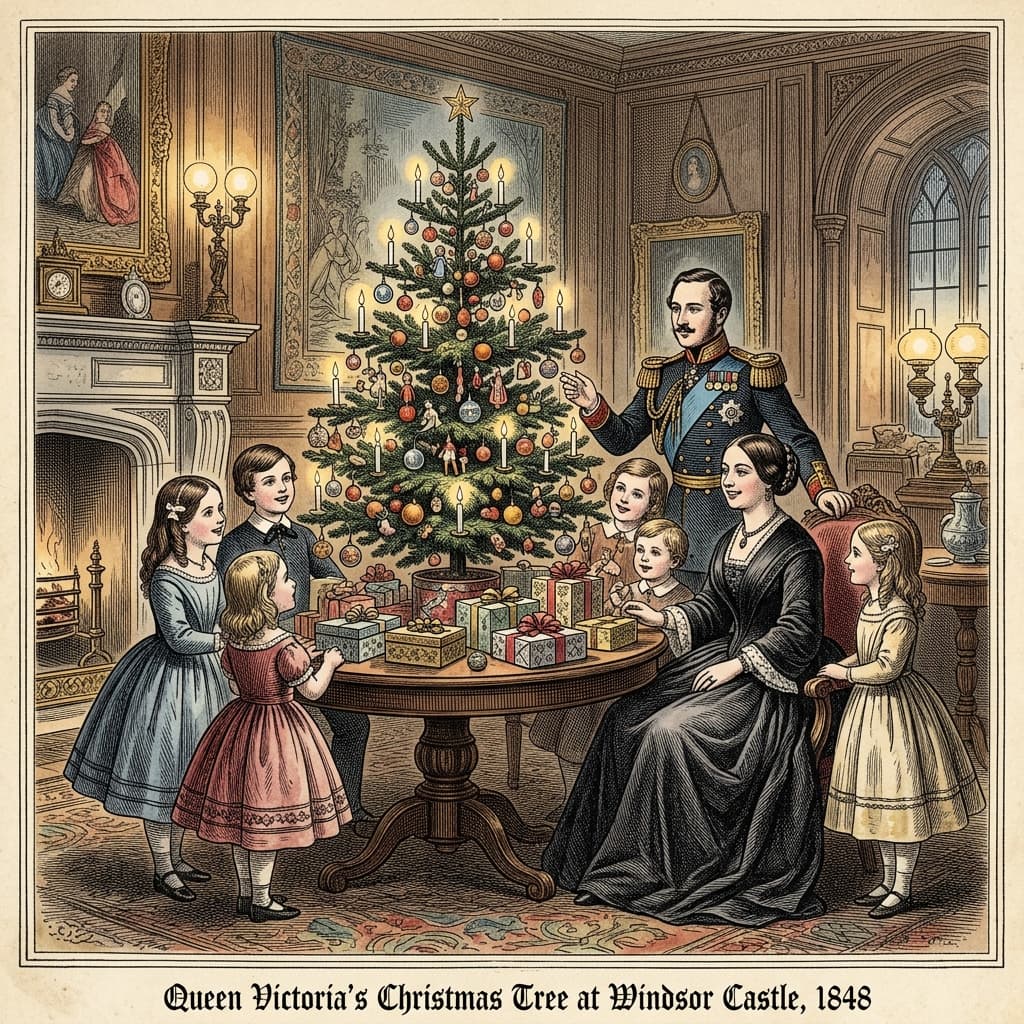
A reproduction of the famous 1848 illustration of Windsor Castle's Christmas tree that sparked the public craze.
When Did Christmas Trees Come to America?
Christmas trees were present in parts of North America before the Victorian era, but they became widely popular in the United States during the 19th century.
German-speaking immigrants brought Christmas customs with them. There are early records of Christmas trees and tree-like displays in Pennsylvania German and Moravian communities during the late 18th and early 9th centuries.
However, the tradition was not immediately accepted across the country. Some Americans viewed Christmas trees as strange or connected with customs they considered inappropriate. New England Puritans had particularly strong objections to Christmas celebrations. That began to change as immigration, publishing, and changing ideas about Christmas reshaped American holiday culture.
How Godey's Lady's Book Changed the American Christmas Tree
Godey's Lady's Book helped popularize the Christmas tree in the United States by reproducing an image of Queen Victoria's family around their Christmas tree.
The original royal image appeared in the Illustrated London News in 1848. Godey's Lady's Book later published a modified version for its American audience in 1850.
The American version removed some obvious royal details—such as Victoria's tiara and Albert's sashes—making the scene look more like an ordinary family celebration. This was a powerful publishing decision. It told American readers: "This isn't just something a European royal family does. This can be part of your family's Christmas too." By the second half of the 19th century, Christmas trees were becoming increasingly common in American homes.
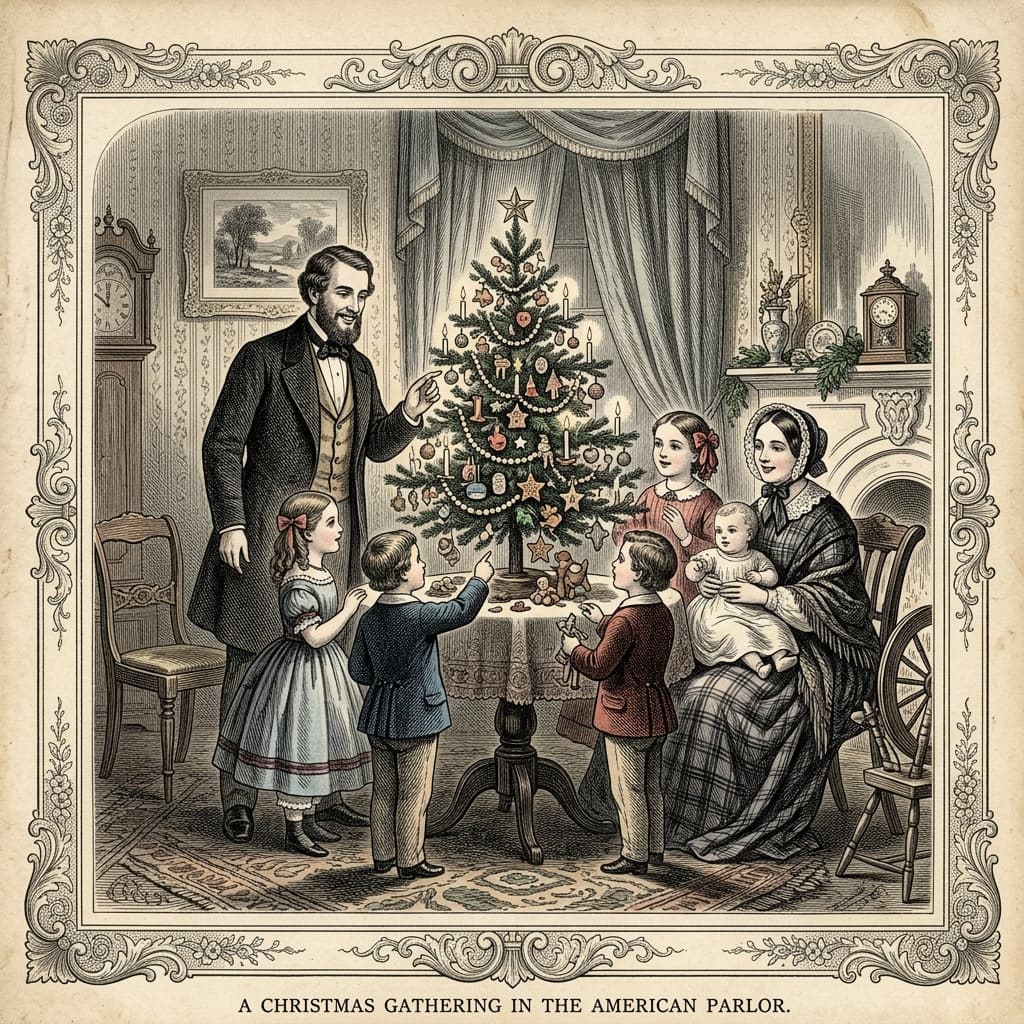
An illustration in the style of Godey's Lady's Book (1850) that Americanized the Christmas tree.
When Did Christmas Trees Become Popular in America?
Christmas trees became broadly popular in the United States during the second half of the 19th century.
Several forces helped the tradition grow:
- German immigration: Immigrants carried customs that were adopted by neighbors.
- Popular magazines: Publications like Godey's Lady's Book provided blueprints.
- Queen Victoria: Gave the tradition social status.
- Commercial decorations: German-made glass ornaments became widely available.
- Electricity: Electric lights made larger and more dramatic displays possible.
During the 19th century, Christmas increasingly became a family-centered holiday. The Christmas tree fit perfectly into that new style of celebration.
When Did Electric Christmas Tree Lights Begin?
Electric Christmas tree lights appeared in the late 19th century and gradually replaced dangerous candles.
Before electricity, candles were attached to tree branches. They looked beautiful but could easily start fires. The arrival of electric lighting changed Christmas trees dramatically.
Edward H. Johnson, an associate of Thomas Edison, is widely credited with creating an early string of electric Christmas tree lights in 1882. Electric lighting allowed trees to remain illuminated for longer periods without the same open-flame danger. Over time, electric lights became cheaper and more widely available. Eventually, colored bulbs and later LED technology transformed Christmas trees into the bright displays we know today.
Why Do We Put Decorations on Christmas Trees?
Tree decorations developed from a mixture of religious symbolism, seasonal customs, local traditions, and later commercial Christmas culture.
Early German traditions included decorations such as:
- Apples (Garden of Eden Paradise tree symbol)
- Wafers (Eucharist symbols)
- Nuts, gingerbread, and sweets
- Handmade paper decorations
- Candles
Over time, handmade decorations were joined by manufactured ornaments. Glass ornaments from German-speaking Europe became increasingly popular. In America, families also used popcorn, cranberries, paper chains, candy, and homemade ornaments. The modern Christmas tree is therefore a visual record of many different traditions.
Why Do We Put a Star or Angel on Top of the Tree?
Stars and angels became popular Christmas-tree toppers because both are connected with the Christian Christmas story.
A star can represent the Star of Bethlehem, which guided the Magi to the baby Jesus. An angel can represent the angels associated with the nativity story, such as the announcement to the shepherds.
The exact history of tree toppers varies by region and family. Some families use stars, while others use angels. Modern families may also use bows, Santa figures, snowflakes, or other decorations. The important point is that the topper has become one of the tree's most recognizable and symbolic features.
When Did the White House Christmas Tree Tradition Begin?
The U.S. National Christmas Tree tradition began in 1923 under President Calvin Coolidge.
The first National Community Christmas Tree was placed on the Ellipse south of the White House in 1923. The event became an important part of the American holiday season. The National Park Service preserves a detailed history of the National Christmas Tree ceremonies.
The tradition continued through changing administrations, wars, national tragedies, and major changes in American culture. The tree became more than decoration; it became a symbol of national celebration.
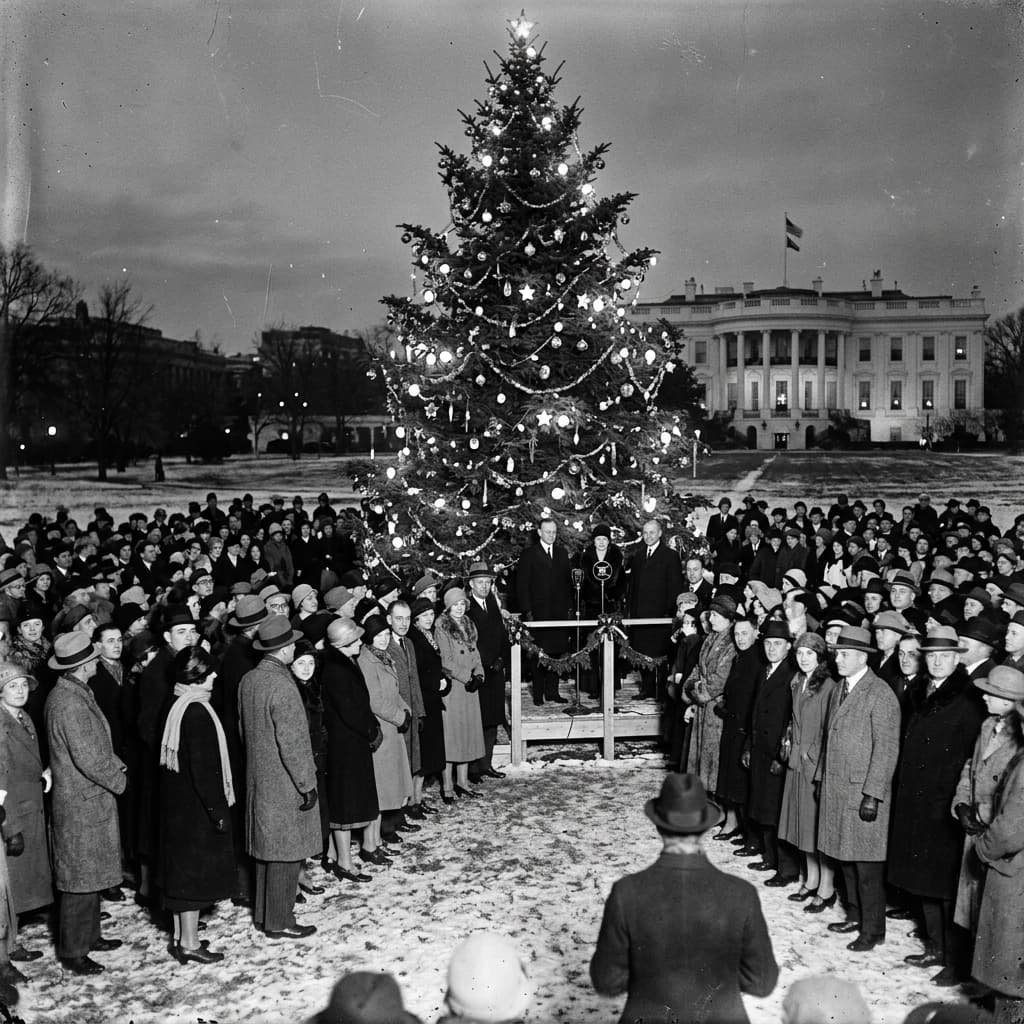
A historical depiction in the style of early National Christmas Tree lighting ceremonies on the Ellipse (1923).
How the Rockefeller Center Christmas Tree Became Famous
The Rockefeller Center Christmas Tree became one of America's most famous Christmas traditions after its first tree appeared in 1931.
The first Rockefeller Center tree was relatively modest, erected by construction workers during the Great Depression. It was not initially the enormous televised spectacle people know today. A formal lighting ceremony followed in 1933.
Over the decades, the tree grew into a major New York City Christmas tradition. Today, the Rockefeller Center tree is one of the most recognizable Christmas trees in the world. Its history also shows how Christmas trees moved from private homes into large public spaces.
Are Christmas Trees Pagan?
The safest historical answer is that ancient evergreen customs existed before Christianity, but there is not enough evidence to describe the modern Christmas tree as simply a direct survival of an ancient pagan tree ritual.
This subject causes a great deal of confusion. Yes, ancient cultures used evergreen plants. Yes, some pre-Christian winter traditions involved greenery. But that does not prove that the modern decorated Christmas tree was directly copied from one ancient pagan ceremony.
The documented development of the Christmas tree points much more clearly toward medieval and early modern European Christian traditions, particularly those that developed in German-speaking regions.
Interactive Timeline: 500 Years of Christmas Tree History
Click and explore the milestones of the Christmas tree's historical journey:
Evergreen Symbolism
Various cultures use evergreen boughs during winter to symbolize life, endurance, and the return of light.
The Paradise Tree
Mystery plays about the Garden of Eden on December 24 use a pine tree hung with apples (representing the Tree of Knowledge), establishing decorated evergreen associations.
The Disputed Riga Claim
Latvian merchant guild records describe a decorated tree, though historians debate if it represents the modern Christmas tree tradition.
Strasbourg Cathedral Record
A decorated Christmas tree is raised inside the Strasbourg Cathedral, marking a documented early Christian church tradition in Alsace.
Early Indoor Decorated Trees
Historical diaries record Strasbourg residents bringing fir trees into their parlors and decorating them with paper roses, apples, wafers, and sugar candies.
Queen Charlotte's Court Tree
The German-born wife of King George III introduces a decorated Christmas tree to the British royal court, beginning a high-society trend.
Royal Family Illustration
The Illustrated London News publishes an engraving of Queen Victoria, Prince Albert, and their children around Windsor Castle's decorated tree, sparking a massive public craze.
Godey's Lady's Book in America
The popular magazine publishes a modified American version of the royal illustration, popularizing decorated trees in middle-class U.S. homes.
First Electric Tree Lights
Edward H. Johnson, an associate of Thomas Edison, strings colored electric bulbs around a Christmas tree, beginning the transition away from fire-hazard candles.
First National Christmas Tree
President Calvin Coolidge lights the first National Community Christmas Tree on the Ellipse south of the White House.
First Rockefeller Center Tree
Construction workers during the Great Depression erect a simple evergreen at the Rockefeller Center site, starting an iconic New York City public tradition.
Christmas Tree History Timeline
| Date/Period | Historical development |
|---|---|
| Ancient world | Evergreen plants were used in various winter customs. |
| Middle Ages | Christian European traditions used evergreen symbolism in different forms. |
| 14th–15th C. | Paradise-tree traditions connected evergreens with Adam and Eve. |
| 1510 | Riga records a disputed early decorated-tree tradition. |
| 1530s | Records from Alsace show Christmas-tree activity. |
| 1539 | A Christmas tree was reportedly raised at Strasbourg Cathedral. |
| 1600s | Decorated trees became established in parts of German-speaking Europe. |
| 18th century | Christmas-tree customs spread further across Europe. Late 1700s, German Christmas traditions appeared in North America. |
| 1800 | Queen Charlotte is associated with a Christmas tree at the British royal court. |
| 1848 | Famous image of Queen Victoria and Prince Albert around a Christmas tree published. |
| 1850s | Godey's Lady's Book helped popularize the tree in America. |
| 1850 onward | Commercial Christmas-tree sales developed in the United States. |
| 1880s | Electric Christmas lights began replacing candles. |
| 1901 | One of the earliest U.S. Christmas-tree farms was established in New Jersey. |
| 1912 | Major community Christmas trees appeared in several U.S. cities. |
| 1923 | First National Christmas Tree ceremony in Washington, D.C. |
| 1931 | First Rockefeller Center Christmas tree placed by workers. |
| 1933 | First official Rockefeller Center tree-lighting ceremony. |
| 20th century | Artificial trees and electric lights became increasingly popular. |
| Today | Christmas trees are a global holiday tradition representing family and celebration. |
These dates represent key milestones in the cultural evolution of the Christmas tree, rather than absolute starting points.
Christmas Tree History: Myths vs. Facts
Separate folklore from historical evidence in the origins of Christmas trees:
| Popular claim | Status | What the evidence suggests |
|---|---|---|
| The Christmas tree was invented by one person | False | No single person invented the Christmas tree. The tradition developed gradually through European winter customs and Christian Paradise trees. |
| Martin Luther definitely invented Christmas-tree lights | False | While Luther is traditionally credited in popular stories, there is no contemporary historical documentation to prove it. |
| The first Christmas tree was definitely in Riga | False | Latvia's 1510 claim is disputed; historians argue the guild event did not represent a decorated Christmas tree in the modern sense. |
| Estonia has the unquestioned first Christmas tree | False | Tallinn's 1441 claim is also highly disputed and lacks verified connection to modern indoor Christmas tree traditions. |
| Christmas trees developed in Central Europe | Correct | Strong historical evidence places the emergence of the decorated indoor Christmas tree in 16th-century Alsace and surrounding German-speaking regions. |
| Queen Victoria invented Christmas trees | False | Decorated trees existed centuries earlier. Victoria and Prince Albert popularized the custom in the UK and USA. |
| Ancient people used evergreens in winter | Correct | Egyptians, Romans, and other ancient cultures used evergreen branches in winter to represent life and spring, but this is separate from the Christmas tree. |
| The modern Christmas tree directly came from one pagan ritual | False | There is no direct lineage. The Christmas tree was a development within medieval European Christian culture, though pre-existing winter greenery customs existed. |
Frequently Asked Questions About Christmas Trees
Where did the Christmas tree originate?
The modern Christmas tree is most strongly associated with German-speaking Central Europe, particularly regions such as Alsace, during the 16th century. Earlier evergreen customs existed elsewhere, but they should not automatically be treated as the same tradition.
Who invented the Christmas tree?
No single person invented the Christmas tree. The tradition developed gradually through European customs, particularly in German-speaking regions.
When did Christmas trees start?
Decorated Christmas trees as a recognizable tradition developed during the late medieval and early modern period, with important evidence appearing in Central Europe during the 16th century.
What was the first Christmas tree?
There is no universally accepted first Christmas tree. Riga has a 1510 claim, Tallinn has another early claim, and historians have questioned whether those events represent modern Christmas-tree traditions. Other evidence points toward 16th-century Central Europe.
Did Christmas trees come from pagan traditions?
Evergreen plants were used by some pre-Christian cultures, especially during winter. However, there is no strong evidence that the modern Christmas tree is simply a direct continuation of one ancient pagan ritual.
Are Christmas trees Christian?
The modern Christmas tree developed within European Christian culture and was given Christian meanings in many communities. Today, Christmas trees are also widely used as secular cultural traditions.
Did Martin Luther invent the Christmas tree?
No reliable evidence proves that Martin Luther invented the Christmas tree or was the first person to put candles on one. The story is a popular tradition associated with him.
When did Christmas trees come to America?
Christmas-tree customs arrived in North America through German-speaking communities and other European immigrants. The tradition became much more popular in the United States during the 19th century.
Why did Queen Victoria make Christmas trees popular?
A famous 1848 illustration showed Queen Victoria, Prince Albert, and their children gathered around a decorated Christmas tree. The image was widely circulated and helped make the tree fashionable among British and American families.
Who brought the Christmas tree to America?
There was no single person responsible. German immigrants and communities helped introduce the tradition, while magazines, royal imagery, commerce, and changing Christmas customs helped spread it.
When did Christmas trees become popular in America?
They became increasingly popular during the second half of the 19th century. By the late 19th and early 20th centuries, the Christmas tree was becoming a familiar part of American Christmas.
Why do we put lights on Christmas trees?
Early Christmas trees were sometimes decorated with candles. Electric lights later provided a safer and longer-lasting alternative and eventually became a standard part of Christmas decorating.
Why do we put a star on a Christmas tree?
The star can represent the Star of Bethlehem from the Christian Christmas story. Some families use an angel instead.
Why do we put presents under the Christmas tree?
The tradition developed alongside the Christmas tree's transformation into a family-centered holiday decoration. Gifts under the tree became an especially strong part of modern Western Christmas celebrations.
When did the White House Christmas tree tradition begin?
The National Christmas Tree tradition began in 1923 when a community Christmas tree was placed on the Ellipse near the White House during Calvin Coolidge's presidency.
When did the Rockefeller Center Christmas tree tradition begin?
The first Rockefeller Center Christmas tree was put up in 1931 by construction workers. The first official lighting ceremony followed in 1933.
How has the Christmas tree changed over time?
Early trees used simple decorations such as apples, candles, nuts, sweets, and paper ornaments. Modern trees often use electric or LED lights, manufactured ornaments, garlands, ribbons, and elaborate toppers.
Why do people still use Christmas trees today?
For many families, the tree represents Christmas, family traditions, celebration, memories, and the start of the holiday season. Its meaning differs from person to person.
Conclusion: An Evolving Holiday Icon
The history of the Christmas tree is much more interesting than the simple claim that someone "invented" it. Evergreen plants were used in winter traditions long before the modern Christmas tree, but the decorated Christmas tree developed much later in Central Europe. German-speaking communities played a major role, and the tradition then spread through Britain and the United States.
The best way to understand the Christmas tree is to see it as a tradition that evolved over time. From Central European customs and Victorian family celebrations to America's White House and Rockefeller Center trees, each generation added something new. Today, the Christmas tree remains one of the world's most recognizable symbols of the holiday season.
Explore More Holiday Research Guides
Countdown Christmas covers the full spectrum of holiday origins, planning, and cultural traditions:
From a 4th-century bishop to the red-suited icon, discover the origins of Santa.
From KFC in Japan to Yule Lads in Iceland, discover global traditions.
The historical reasons and astronomical origins of the midwinter date.
Return to the live countdown calendar showing days until Christmas.
Clara Sterling
Holiday Editor & HistorianClara Sterling is a cultural historian and lifestyle writer specializing in Christmas traditions, holiday folklore, and winter solstice celebrations.