
The History of Santa Claus: From Saint Nicholas to the Modern Santa
Discover how a real Christian bishop in modern-day Turkey evolved over nearly 1,700 years into the legendary Christmas figure recognized around the world.
Santa Claus seems simple at first: a cheerful man in a red suit who visits on Christmas Eve. But his history is much more complicated. The character we know today developed over many centuries from a mix of Christian tradition, European folklore, American literature, art, and popular culture.
The biggest mistake is to look for one person who invented Santa Claus. There wasn't one. Saint Nicholas provided an important historical starting point, while later writers, artists, and retailers shaped the Santa recognized today.
Santa Claus developed from traditions surrounding Saint Nicholas, a Christian bishop associated with Myra in modern Turkey. European traditions such as Sinterklaas later influenced the American Santa, while writers such as Washington Irving and Clement Clarke Moore and illustrator Thomas Nast helped shape the modern character. Coca-Cola did not invent Santa, but its 20th-century advertising helped popularize one familiar version of his red-suited appearance.
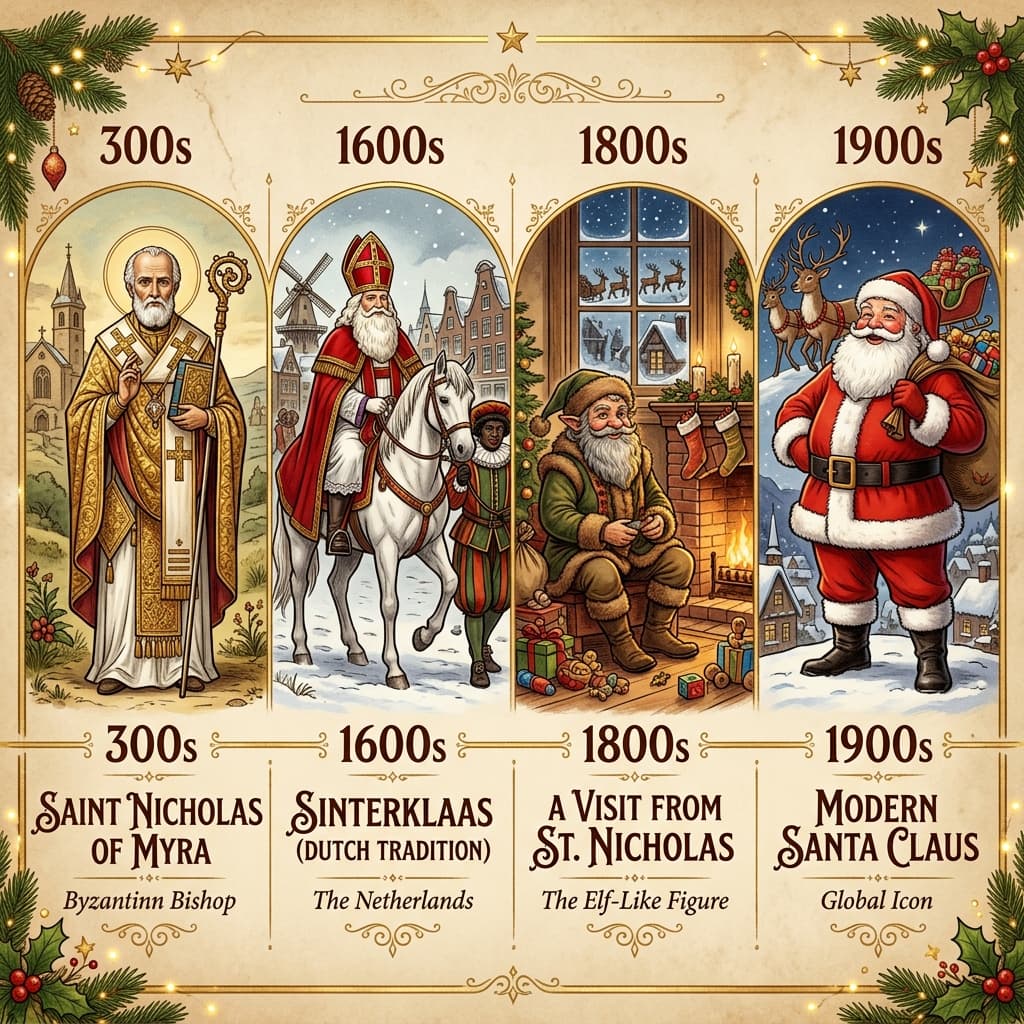
Historical evolution of Santa Claus: showing Saint Nicholas of Myra, Dutch Sinterklaas, Victorian Father Christmas, and the modern Santa.
Who Was Saint Nicholas?
Saint Nicholas was a Christian bishop from Myra in Asia Minor, in what is now Turkey, who became famous for generosity and stories of helping others.
Nicholas is generally believed to have lived during the third and fourth centuries. Historical sources place his birth around A.D. 280 in Patara and associate him with Myra, a coastal city in modern Turkey. Historical details about his life are limited, and many stories about Nicholas were written or developed long after his lifetime.
Where Did Saint Nicholas Live?
Saint Nicholas lived in the Roman province of Lycia in Asia Minor (modern-day Demre, Turkey). He was an Mediterranean bishop, far removed from the cold Arctic environment associated with modern Santa Claus.
Was Saint Nicholas a Real Person?
Most historians accept that Saint Nicholas was a real Christian bishop, although many popular stories about his life cannot be independently verified. He became associated with generosity and children. One famous story says that he secretly provided money to help three poor young women pay dowries. Stories like this helped create his reputation as an anonymous gift giver.
His feast day is traditionally observed on December 6, not December 25.
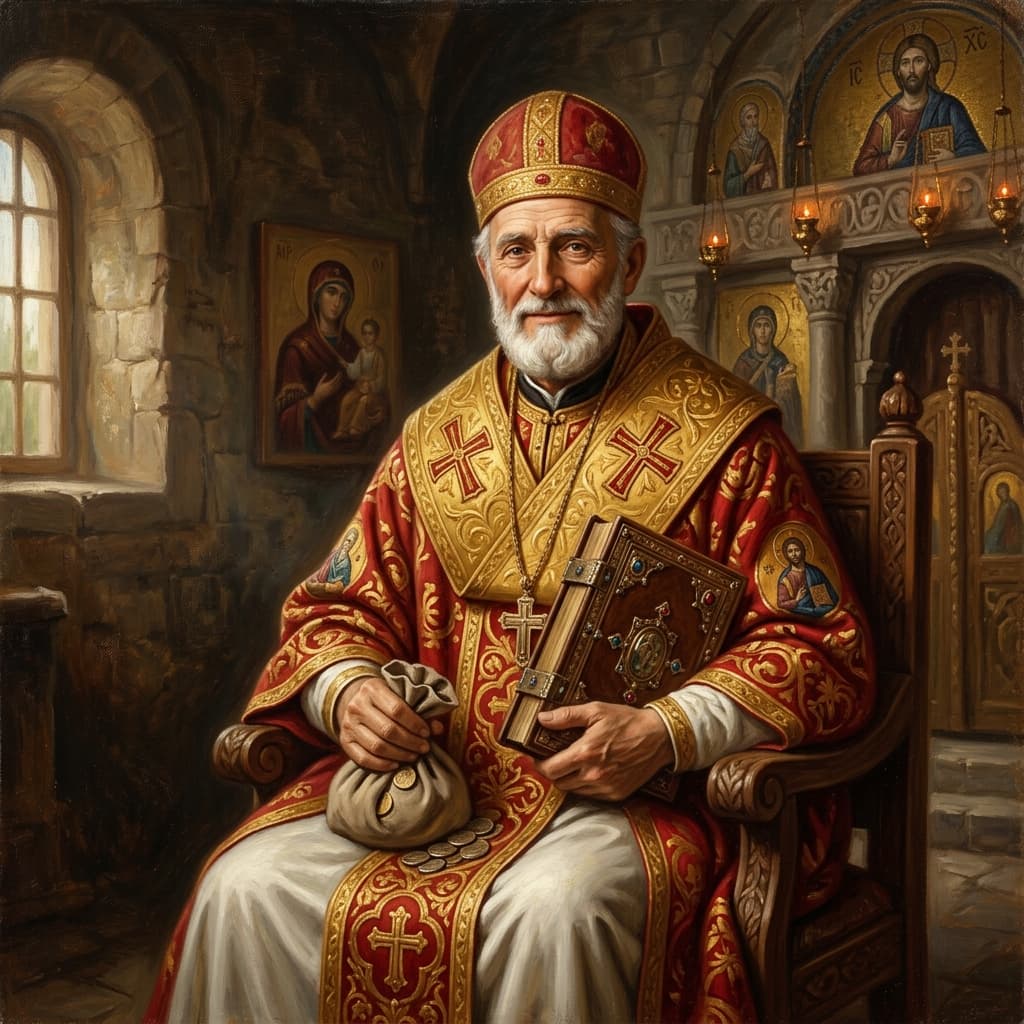
Portrait of Saint Nicholas of Myra in traditional Byzantine bishop vestments.
Why Did Saint Nicholas Become Associated With Gift Giving?
Saint Nicholas became associated with gifts because stories about his secret generosity spread throughout Christian Europe during the Middle Ages.
Nicholas was remembered as someone who helped people in need quietly and generously. Over time, those stories became connected with children and winter gift giving. By the Middle Ages, Saint Nicholas had become one of the most popular saints across Europe.
His December 6 feast day developed its own customs. Children left out shoes or stockings to receive small gifts, coins, sweets, and fruits. This tradition is one of the strongest direct links between the historical Nicholas and today's Santa Claus. To learn more about how holiday gift traditions evolved, read our guide on why we give gifts at Christmas.
How Saint Nicholas Became Sinterklaas
In the Netherlands, Saint Nicholas became known as Sinterklaas, a tradition that later directly influenced the American Santa Claus.
The Dutch form developed from Sint Nikolaas. Dutch communities celebrated Sinterklaas around December 6, with Sinterklaas depicted as a tall, dignified bishop wearing red robes and a mitre, riding a white horse.
When Dutch settlers moved to North America in the 17th and 18th centuries, they brought Sinterklaas traditions to New Amsterdam (modern New York). The phonetic translation of Sinterklaas into English eventually created the name Santa Claus.
Santa Claus Name Evolution
| Stage | Name | Context & Origins |
|---|---|---|
| Historical saint | Nicholas | 4th-century Christian bishop of Myra |
| Latin/Christian tradition | Saint Nicholas | Patron saint of children and gift-giving across Europe |
| Dutch tradition | Sinterklaas | Sint Nikolaas custom brought to North America |
| English-American form | Santa Claus | 18th-19th century American phonetic evolution |
| Modern nickname | Santa | Global Christmas icon and household name |
How Sinterklaas Became Santa Claus in America
Santa Claus developed into a distinctly American Christmas character during the late 18th and early 19th centuries in New York.
Dutch families in New York continued celebrating Saint Nicholas in the 1770s. Key figures like John Pintard, founder of the New York Historical Society, promoted St. Nicholas as the patron saint of New York and distributed broadsides featuring Nicholas bringing gifts to children. For a deep-dive analysis into how Dutch roots, literature, Nast, and department stores transformed the character, read our complete guide on how Santa became popular in America.
Washington Irving's Influence
In his 1809 A History of New York, author Washington Irving presented a humorous, satirical version of St. Nicholas connected with Dutch New York traditions. Irving described St. Nicholas riding over treetops in a wagon, smoking a pipe, and dropping gifts down chimneys. This moved the character away from a solemn bishop toward a whimsical folk figure.
How Clement Clarke Moore Changed Santa
Clement Clarke Moore's 1823 poem helped define the Santa who arrives on Christmas Eve by sleigh and flying reindeer.
First published anonymously in the Troy Sentinel as “A Visit from St. Nicholas” (commonly known as “The Night Before Christmas”), this poem became one of the most influential works in Christmas history.
Santa Details Established by the 1823 Poem:
- Arrival on Christmas Eve
- Miniature sleigh and 8 reindeer
- Named reindeer (Dasher to Blitzen)
- Entry through the chimney
- Sack full of toys on his back
- Jolly elf appearance & round belly
The poem did not invent these ideas out of nowhere; instead, it combined existing European folklore and Dutch traditions into a unified American story. You can also explore how other holiday customs developed in our article on the history of the Christmas tree.
How Thomas Nast Created the Modern Santa Image
Illustrator Thomas Nast established the visual identity of Santa Claus as a large, white-bearded man in a suit operating from the North Pole.
Beginning in the 1860s, political cartoonist Thomas Nast created annual Santa illustrations for Harper's Weekly. Over 30 years of drawings, Nast gave Santa:
- A full-sized, cheerful human body with a white beard
- A red-and-fur suit (though he also drew him in brown/tan)
- A workshop where toys are made for children
- A record book of naughty and nice children
- A home address at the North Pole
- Mrs. Claus (who first appeared in literature in 1849)
Why Does Santa Live at the North Pole?
The North Pole became Santa's home through 19th-century American illustration, not ancient history. Nast chose the Arctic because polar exploration was widely reported in newspapers at the time, and the remote, frozen landscape was a neutral, magical location for a global gift giver. In 1866, Nast published a drawing explicitly referencing "Santa Claussville, N.P."
Was Santa Always Dressed in Red?
No. Santa's outfit varied in color throughout the 19th century before red became standard.
During the 1800s, Santa was depicted in robes of green, blue, brown, purple, and tan. Red became increasingly popular in late 19th-century prints and magazine covers, partly reflecting Saint Nicholas's original red bishop robes and Victorian printing trends. By the 1900s, red was already his most common color.
Interactive Santa Claus Timeline
Click and explore the milestones of Santa's 1,700-year evolution:
Saint Nicholas of Myra
Born in Patara (modern Turkey), Nicholas becomes a Christian bishop famous for his generosity, secret gift-giving, and protection of those in need.
Gift-Giving Traditions Spread
Nicholas's popularity spans Europe. In many regions, children begin receiving coins, sweets, and small treats on his December 6th feast day.
Dutch Sinterklaas Custom
Even after the Reformation, Dutch communities keep the traditions of 'Sinterklaas' (a short form of Sint Nikolaas) alive, eventually carrying these customs to North America.
Washington Irving's Reshaping
Irving writes a satirical history of New York featuring a cheerful, pipe-smoking Dutch Saint Nicholas who rides in a flying wagon, moving the character from bishop to folklore.
"A Visit from St. Nicholas"
First published anonymously in Troy, NY (and later attributed to Clement Clarke Moore), this iconic poem popularizes a sleigh, eight flying reindeer, and a chimney visit on Christmas Eve.
Thomas Nast Creates the Image
Cartoonist Thomas Nast illustrates Santa for Harper's Weekly, standardizing the jolly, white-bearded figure in a suit, giving him a workshop, and placing him at the North Pole.
The Coca-Cola Campaigns
Illustrator Haddon Sundblom paints a warm, human, grandfatherly Santa in a bright red suit for Coca-Cola ads, establishing this specific look as the global standard.
Rudolph the Red-Nosed Reindeer
Robert L. May creates Rudolph for a Montgomery Ward holiday booklet, adding a ninth reindeer and a new chapter to the classic sleigh-ride legend.
NORAD Tracks Santa Begins
A misprinted newspaper phone number leads children to call the Continental Air Defense Command, starting the annual radar tracking tradition that continues today.
★ Santa Claus Timeline: From Saint Nicholas to Today
| Period | Important development |
|---|---|
| 3rd–4th century | Saint Nicholas lived in the region of modern-day Turkey. |
| Middle Ages | Stories about Nicholas spread throughout Europe; he became associated with children and gift-giving. |
| 1500s onward | Religious and cultural changes transformed European gift-giving traditions. |
| 1700s | Dutch Sinterklaas traditions continued in New York; early written references to Santa Claus appear in the 1770s. |
| 1809 | Washington Irving popularized a fictionalized Dutch Saint Nicholas. |
| 1821 | The Children's Friend booklet developed a Christmas gift-giver riding a sleigh pulled by a reindeer. |
| 1823 | A Visit from St. Nicholas popularized the sleigh, eight named reindeer, chimney entry, and Christmas Eve timing. |
| 1860s onward | Thomas Nast illustrated Santa for Harper's Weekly, creating the beard, suit, naughty list, and North Pole home. |
| 1931 | Haddon Sundblom's Coca-Cola Santa campaign began, standardizing his friendly grandfatherly persona. |
| 1939 | Rudolph was introduced in a Montgomery Ward holiday booklet written by Robert L. May. |
| 1955 | The radar tracking tradition that became NORAD Tracks Santa began after a child's misdirected phone call. |
| Modern Era | Santa becomes a highly unified, global Christmas icon of joy and generosity. |
Historical sources support the major stages of this timeline, although some individual dates should be understood as milestones in a longer cultural evolution rather than moments when Santa was suddenly “created.”
★ Santa Claus Myths vs. Historical Facts
Many popular Santa stories contain a mixture of historical evidence, folklore, literature, and modern commercial culture:
| Popular claim | Status | Historical reality |
|---|---|---|
| Santa Claus was invented by Coca-Cola | False | Santa's modern look and red suit were already well-established. Coca-Cola's ads standardized and popularized this friendly image globally. |
| Saint Nicholas and Santa Claus are exactly the same | False | Saint Nicholas was a real 4th-century Byzantine bishop. Santa Claus is a later cultural composite inspired by Nicholas, Dutch folklore, and 19th-century American writers. |
| Santa's name comes from Sinterklaas | Correct | The name 'Santa Claus' is the American phonetic derivation of the Dutch 'Sinterklaas' (Sint Nikolaas). |
| Santa's eight original reindeer were created in 1823 | Correct | The eight reindeer (Dasher through Blitzen) first appeared together and were named in the 1823 poem 'A Visit from St. Nicholas'. |
| Santa Claus has always worn red | False | Historical illustrations and descriptions from the 19th century depict him in various colors, including green, blue, brown, and purple, before red became standard. |
| Rudolph was one of the original reindeer | False | Rudolph was created more than a century later, in 1939, as a promotional marketing campaign for the retail store Montgomery Ward. |
The most important lesson is that Santa Claus is a composite cultural figure. He did not have one inventor. He developed through centuries of religious tradition, folklore, literature, art, commerce, and popular culture.
What Happened to Santa in the 20th Century?
During the 20th century, Santa Claus expanded through advertising, retail, radio, movies, television, books, and popular music. The character became much more consistent. Children increasingly recognized the same basic Santa: white beard, red suit with black boots and belt, round body, reindeer, sleigh, North Pole, workshop, and elves.
Modern entertainment added even more details. Movies such as Miracle on 34th Street helped explore the idea of Santa in American popular culture. Rudolph also became a major part of the Christmas story after his creation in 1939. HISTORY notes that Montgomery Ward distributed millions of copies of the original Rudolph story.
Another modern tradition is Santa tracking. The organization now known as NORAD began its Santa-tracking tradition in 1955 after a child accidentally called the Continental Air Defense Command while trying to reach Santa.
Frequently Asked Questions About the History of Santa Claus
Who was the real Santa Claus?
The historical person most closely connected with Santa Claus is Saint Nicholas, a Christian bishop associated with Myra in what is now Turkey. The modern Santa Claus, however, is a later cultural character created from many traditions.
Where did Santa Claus originate?
The deepest historical roots of Santa Claus are connected to Saint Nicholas in Asia Minor, particularly the region of Myra in modern-day Turkey. The modern American Santa developed much later through European and American traditions.
Is Santa Claus based on a real person?
Yes. Santa Claus is traditionally based in large part on Saint Nicholas. However, the modern Santa character is not a historical biography of Nicholas. It is a combination of history, folklore, literature and popular culture.
Where does the name Santa Claus come from?
The name Santa Claus developed from the Dutch Sinterklaas, which comes from Sint Nikolaas, or Saint Nicholas.
Did Coca-Cola invent Santa Claus?
No. Coca-Cola did not invent Santa Claus or the red suit. Its 20th-century advertising campaigns helped popularize and standardize a version of Santa that already existed.
Why does Santa wear red?
Red became an important part of Santa's appearance during the 19th century and was reinforced by later illustrations and advertising. Coca-Cola helped popularize the familiar red-and-white image but did not create it.
Who created Santa's modern appearance?
No single person created it. Clement Clarke Moore's poem shaped the literary character, while Thomas Nast played a major role in developing Santa's visual appearance. Later artists and advertisers, including Haddon Sundblom, further standardized the image.
When did Santa Claus come to America?
Saint Nicholas traditions were present among Dutch communities in colonial New York. The character became increasingly popular in wider American culture during the late 18th and especially the 19th century.
Who wrote “The Night Before Christmas”?
The poem A Visit from St. Nicholas is traditionally attributed to Clement Clarke Moore, but its authorship has been debated. It was first published anonymously in 1823.
When did Santa get his reindeer?
The eight famous reindeer were named in the 1823 poem A Visit from St. Nicholas. Rudolph was added much later, in 1939.
When did Santa start living at the North Pole?
The North Pole became part of Santa's mythology during the 19th century, with Thomas Nast playing an important role in establishing that association.
Is Saint Nicholas the same as Santa Claus?
No. Saint Nicholas was a historical Christian bishop surrounded by centuries of tradition. Santa Claus is a later cultural character that developed partly from the stories and traditions associated with Nicholas.
How old is Santa Claus?
There is no single age for Santa Claus because the character developed gradually. The oldest major historical root is Saint Nicholas, who lived in the third and fourth centuries. The modern American Santa took shape mainly during the 19th century.
How did Santa become associated with Christmas Eve?
Early Saint Nicholas traditions were strongly associated with December 6. American literary traditions gradually moved the gift-giving figure toward Christmas, especially through 19th-century literature and the popularity of A Visit from St. Nicholas.
Conclusion: A Legend Built Over Generations
The history of Santa Claus is not the story of one inventor creating a fictional character. It is the story of a figure changing across centuries. Saint Nicholas provided the historical foundation, European traditions added new customs, Dutch settlers carried Sinterklaas to America, American writers reshaped the character, Thomas Nast transformed his appearance, and later advertising and entertainment made the modern Santa familiar around the world.
If you want to understand Santa Claus today, it helps to separate history from folklore. Saint Nicholas was a historical religious figure, while the red-suited man at the North Pole is a cultural character built over generations. That long evolution is what makes the Santa Claus story so interesting—and why the tradition continues to change.
Explore More Holiday Research Guides
Countdown Christmas covers the full spectrum of holiday origins, planning, and cultural traditions:
The real story of the 4th-century bishop of Myra who inspired Santa Claus.
From KFC in Japan to Yule Lads in Iceland, discover global traditions.
The fascinating origin of Santa's famous laugh and catchphrase.
Track the exact time, hours, and minutes remaining until December 24th.
Return to the live countdown calendar showing days until Christmas.
Clara Sterling
Holiday Editor & HistorianClara Sterling is a cultural historian and lifestyle writer specializing in Christmas traditions, holiday folklore, and winter solstice celebrations.