
History of Christmas Cards: Who Invented Them and Why We Send Them
Discover the history of Christmas cards, who invented the first one in 1843, how they reached America, and why this Victorian custom still matters today.
A Christmas card can look like a small part of the holiday, but its history is surprisingly rich. Before cards were common, people often wrote Christmas letters or visited friends and relatives in person. For someone with a long list of people to contact, that could take a great deal of time.
The modern Christmas card grew out of that simple problem in Victorian England. In 1843, Sir Henry Cole commissioned artist John Callcott Horsley to create a printed Christmas greeting. The idea eventually spread from Britain to the United States and became one of the world's best-known holiday traditions.
The first commercially produced Christmas card was created in London in 1843. Sir Henry Cole commissioned artist John Callcott Horsley to design it as a convenient way to send Christmas greetings. About 1,000 copies were printed, and the idea eventually spread throughout Britain and the United States.
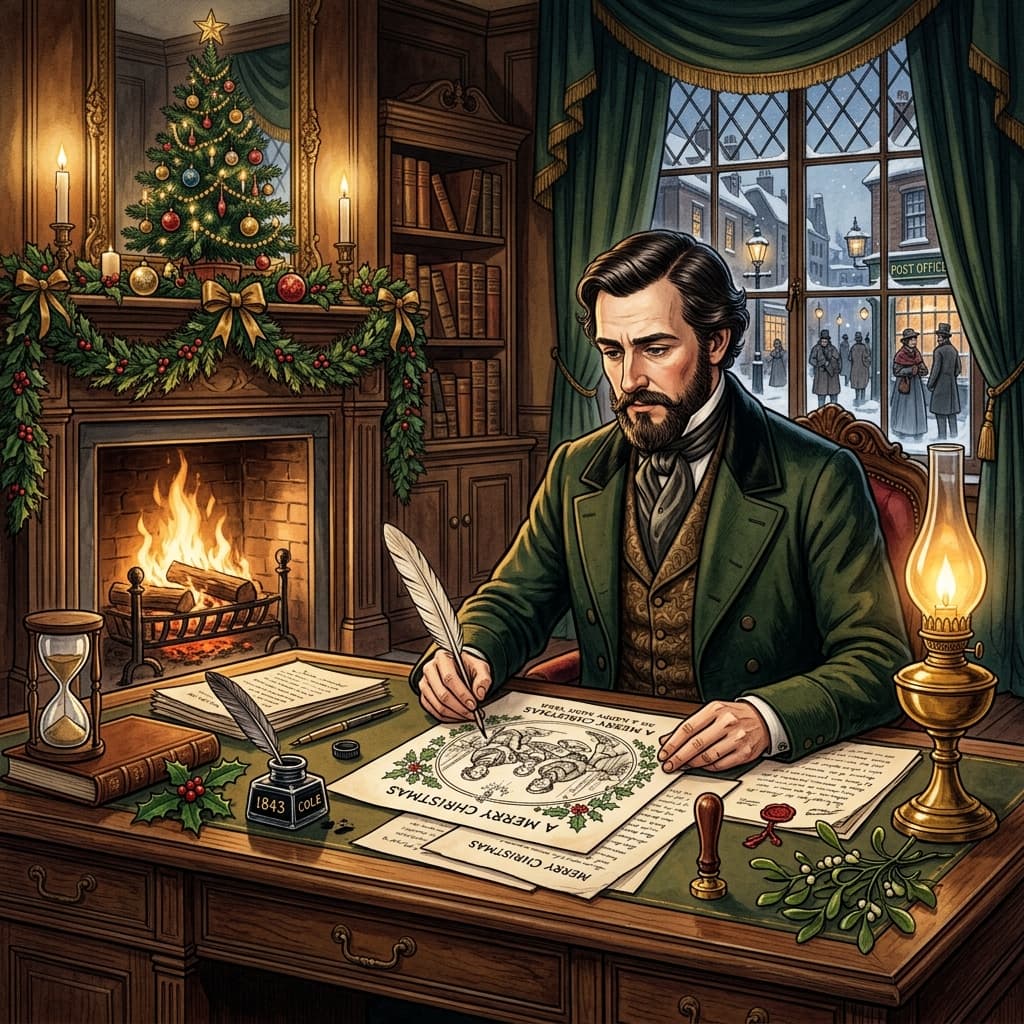
Recreation of Sir Henry Cole drafting his seasonal greetings, leading to the invention of the Christmas card in 1843.
Who Invented the Christmas Card?
Sir Henry Cole is generally credited with introducing the first commercially produced Christmas card in 1843, with artwork by John Callcott Horsley.
Cole was an English civil servant, educator, inventor, and arts organizer who later became the first director of the Victoria and Albert Museum (V&A). In 1843, Cole faced a very ordinary problem: he had too many Christmas greetings to answer.
The recent development of cheaper postal communication had encouraged more people to send letters and seasonal greetings. Cole needed a faster way to respond to his large circle of friends, so he asked his artist friend John Callcott Horsley to create a design that could be printed and sent to many people.
Why Did Henry Cole Create the First Christmas Card?
Henry Cole created the card mainly as a practical way to send Christmas greetings without writing a separate long letter to every acquaintance. He was already involved in reforming Britain's postal system, having helped set up the Uniform Penny Post in 1840, which made mailing a letter cost only one penny.
This reform made postal communication accessible to the masses, resulting in a surge of mail. In Victorian etiquette, failing to answer a letter was considered rude. Cole's solution was clever: create one attractive printed greeting that could be personalized with a quick note and mailed.
What Did the First Christmas Card Look Like?
The first commercial Christmas card showed a Victorian family celebrating around a table, surrounded by scenes of charity. The design was divided into three panels:
- The Central Panel: Showed three generations of a family raising a glass of wine to toast the recipient.
- The Side Panels: Showed acts of charity, with people feeding the hungry and clothing the poor.
- The Greeting: Carried the words "A Merry Christmas and A Happy New Year To You."
🍷 An Early Controversy
The central panel showing a child taking a sip of wine caused a minor scandal. The Victorian temperance movement, which campaigned against alcohol abuse, criticized the design, arguing that it promoted drinking to children.
What Happened to the First Christmas Cards?
Cole commissioned about 1,000 copies of the 1843 design. They were printed by lithography and hand-colored by professional colorists. The unused cards were sold for one shilling each—which was quite expensive at the time (equivalent to a day's wages for a laborer).
Because of the high price and the minor wine controversy, the card was not an immediate commercial success. However, the idea had been planted, and other printers soon designed their own versions. Today, only a handful of original 1843 Cole-Horsley cards survive, and they are highly sought after by museums and collectors, selling at auctions for thousands of dollars.
When Did Christmas Cards Become Popular?
Christmas cards became a mass tradition during the second half of the 19th century. As industrial printing technology progressed, color printing (chromolithography) became faster and cheaper. At the same time, postal rates dropped even further, and rising literacy rates meant more people were writing cards.
By the 1860s and 1870s, Christmas cards had become a full-fledged craze in Britain. Millions of cards were posted each year, and people began collecting them in albums, sharing them with visitors as home decor.
How Victorian Christmas Cards Changed
As the industry grew, Victorian card designs expanded. Printers used embossed paper, lace borders, metallic gold ink, and silk tassels. The illustrations also helped establish early Christmas symbols that remain popular today, including snow scenes, robins, holly, mistletoe, and evergreen wreaths.
Why Were Some Victorian Christmas Cards So Strange?
If you look at old Victorian cards, you will find some very bizarre and creepy designs. Cards featured dead birds, frogs riding bicycles, dancing insects, anthropomorphic vegetables, and menacing snowmen.
This was because Christmas card iconography was still in its infancy. Designers focused on novelty, good luck symbols (such as dead birds, which were sometimes associated with luck in folklore), and lighthearted winter humor rather than standardized religious or Santa imagery.
How Did Christmas Cards Come to America?
In the mid-19th century, wealthy Americans imported Christmas cards from Europe. The domestic greeting card industry in the United States did not take off until the 1870s, largely driven by one innovative printer.
Who Was Louis Prang?
Louis Prang was a German immigrant who opened a print shop near Boston. He perfected the art of chromolithography, using up to 20 or more colored stones to print highly detailed, oil-painting-like designs.
Prang printed his first Christmas cards for export to London in 1873, and began selling them in the United States in 1874 (some sources cite 1875). His cards were of exceptional artistic quality, featuring flowers, birds, and children, and they became an instant sensation. By the 1880s, Prang was printing over five million cards a year, earning him the title "Father of the American Christmas Card."
How Did Hallmark Change Christmas Cards?
By the early 20th century, cheap postcard greetings flooded the market, and Louis Prang's expensive art cards declined. In 1910, Joyce Hall founded the Hall Brothers company in Kansas City (which later became Hallmark Cards).
In 1915, the company launched its first holiday greeting cards. Hallmark revolutionized the industry by introducing the **folded card format tucked inside an envelope**. This allowed people more privacy to write a personal message compared to a postcard, establishing the standard card format used today.
First Christmas Card vs. Modern Christmas Card
Greeting cards have evolved dramatically since Cole's first batch in 1843:
| Feature | First Commercial Card (1843) | Modern Card (Today) |
|---|---|---|
| Format | Single-sided postcard-style stiff board | Folded card in envelope, photo card, or digital |
| Artwork | Family raising a toast and scenes of charity | Huge range (Santa, nature, humor, religious, custom photos) |
| Production | Lithographed and colored by hand | Mass-printed digitally, with foil, music, or pop-ups |
| Cost | One Shilling (expensive) | Affordable mass-market pricing |
| Primary Purpose | Practical solution to save time replying to letters | Maintaining connections and celebrating tradition |
Why Do We Send Christmas Cards Today?
Even in the age of instant messaging, text messages, and social media updates, physical Christmas cards remain popular. For many families, mailing cards is a seasonal ritual that marks the start of December.
Receiving a physical card in the mail is highly valued because it represents time, effort, and thoughtfulness. It gives people a way to reconnect with distant friends, share family photos, express appreciation, and spread holiday cheer.
Christmas Card History Timeline
Key milestones in the historical journey of the Christmas card:
The Penny Post Revolution
Britain introduces the Uniform Penny Post, making the sending of letters and greetings affordable to ordinary citizens.
The First Commercial Christmas Card
Sir Henry Cole commissions artist John Callcott Horsley to design a ready-to-mail Christmas greeting card to save time. 1,000 copies are printed.
Egley's Early Design
Artist William Maw Egley designs another famous early card, showing festive family dinners and ice-skating scenes.
Chromolithography Boom
Advanced printing technologies allow for bright colors, gold stamping, and lace embossing, lowering costs and increasing demand.
Christmas Cards Come to America
Printers begin importing cards. German-born Louis Prang opens his printing business near Boston, beginning high-quality domestic production.
Prang's Golden Age
Prang's company prints millions of high-quality Christmas cards decorated with flowers and natural scenes, earning him the title 'Father of the American Christmas Card'.
Postcard Popularity
Inexpensive postcards become popular, offering a quick, envelope-free way to send short Christmas greetings.
Hallmark is Born
The Hall Brothers publish their first line of holiday greeting cards, laying the foundation for Hallmark.
The Envelope Standard
The folded card tucked inside an envelope becomes the cultural standard in the US, allowing more space for personal letters.
First US Christmas Stamp
The US Post Office issues its first Christmas stamp, encouraging seasonal mailing practices.
Physical Coexistence with Digital
Physical holiday cards remain a massive seasonal tradition alongside family photo cards, digital e-cards, and social media greetings.
Did You Know?
📬 Postal reform paved the way
Before the Penny Post in 1840, sending mail in Britain was expensive and paid for by the recipient. Cheaper postage allowed greeting cards to become a mass custom.
🎨 Original art card price
Sir Henry Cole's cards cost one shilling each in 1843. This was the equivalent of a laborer's daily wage, making them a luxury item.
🦉 Strange Victorian motifs
Victorian cards could feature bizarre and creepy drawings, including dead robins (representing luck) and frogs fighting.
✉️ Hallmark's envelope idea
Hallmark revolutionized the greeting card industry by introducing the folded card inside an envelope, which offered privacy and more space for personal writing.
Frequently Asked Questions
Who invented the first Christmas card?
Sir Henry Cole is generally credited with introducing the first commercially produced Christmas card in 1843. Artist John Callcott Horsley created the design.
When was the first Christmas card sent?
The first commercially produced Christmas card dates to 1843, when Henry Cole commissioned the design in London.
Who designed the first Christmas card?
John Callcott Horsley designed the famous 1843 Christmas card commissioned by Henry Cole.
What did the first Christmas card say?
It carried the greeting “A Merry Christmas and A Happy New Year To You.”
What did the first Christmas card look like?
It showed three generations of a family celebrating in the center, with scenes of charity on either side.
Why did Henry Cole make a Christmas card?
He wanted a faster way to send Christmas greetings to his large circle of friends and acquaintances without writing individual letters to everyone.
Were the first Christmas cards popular?
Not immediately. They were expensive at one shilling each, so the first commercial venture was considered a commercial failure. The idea became much more successful later as printing and postage became cheaper.
When did Christmas cards become popular?
They became increasingly popular during the second half of the 19th century, especially as printing technology, postal services, literacy and consumer culture developed.
Who introduced Christmas cards to America?
Louis Prang was a major figure in popularizing Christmas cards in the United States during the 1870s.
Who was Louis Prang?
Louis Prang was a German immigrant and printer who became a major American producer of Christmas cards and helped popularize high-quality color printing.
When did Hallmark start making Christmas cards?
Hall Brothers, the company that later became Hallmark, published its first holiday card in 1915.
Why are Victorian Christmas cards sometimes creepy?
Victorian card designers experimented with humor, folklore, animals and unusual imagery. Christmas symbolism was still developing, so cards could look very different from today's familiar holiday designs.
Why do people send Christmas cards?
People send Christmas cards to express holiday wishes, maintain relationships, share family news and continue a seasonal tradition.
Are Christmas cards still popular?
Yes. Physical cards remain an established Christmas tradition, although digital messages and social media have changed how people communicate during the holidays.
Conclusion
The history of Christmas cards began with a simple problem in Victorian England: Henry Cole had too many Christmas greetings to answer. His solution, created with artist John Callcott Horsley in 1843, eventually became a worldwide holiday tradition.
The tradition changed as printing, postage, and consumer culture developed. Louis Prang helped establish the American market, while 20th-century companies such as Hallmark transformed the format. Today, people can choose between a handwritten card, a photo card, or a digital greeting. The format may change, but the basic idea remains the same: take a moment to remember someone and wish them well.
Explore More Holiday Research Guides
Countdown Christmas covers the full spectrum of holiday origins, planning, and cultural traditions:
From 4th-century Saint Nicholas to Sinterklaas and the modern American Santa.
How a Central European tradition became a global symbol of the holiday season.
Explore the historical, religious, and Victorian origins of seasonal gift-giving.
Return to the live countdown calendar showing days until Christmas.
Clara Sterling
Holiday Editor & HistorianClara Sterling is a cultural historian and lifestyle writer specializing in Christmas traditions, holiday folklore, and winter solstice celebrations.