
Why Do We Put Up Christmas Lights? History & Meaning
From candle-lit branches and Edward Johnson's 1882 tree to modern LEDs, discover the history, meaning, and people behind this beloved tradition.
Christmas lights are one of the first signs that the holiday season has arrived. They appear on Christmas trees, windows, porches, streets, and entire neighborhoods, transforming dark winter evenings into vibrant, glowing displays.
But why do we put up Christmas lights in the first place? The answer is a fascinating mix of **religious symbolism, older winter solstice traditions, Christmas-tree history, technological change, and modern American culture**. The tradition began with candles long before electricity. Electric Christmas lights came later, with inventors and marketers playing key roles in making them accessible to households.
We put up Christmas lights because they symbolize light, hope, celebration, and the Christmas season. The tradition began with candles on Christmas trees before electricity and evolved into electric bulbs, outdoor displays, and modern LED lights.
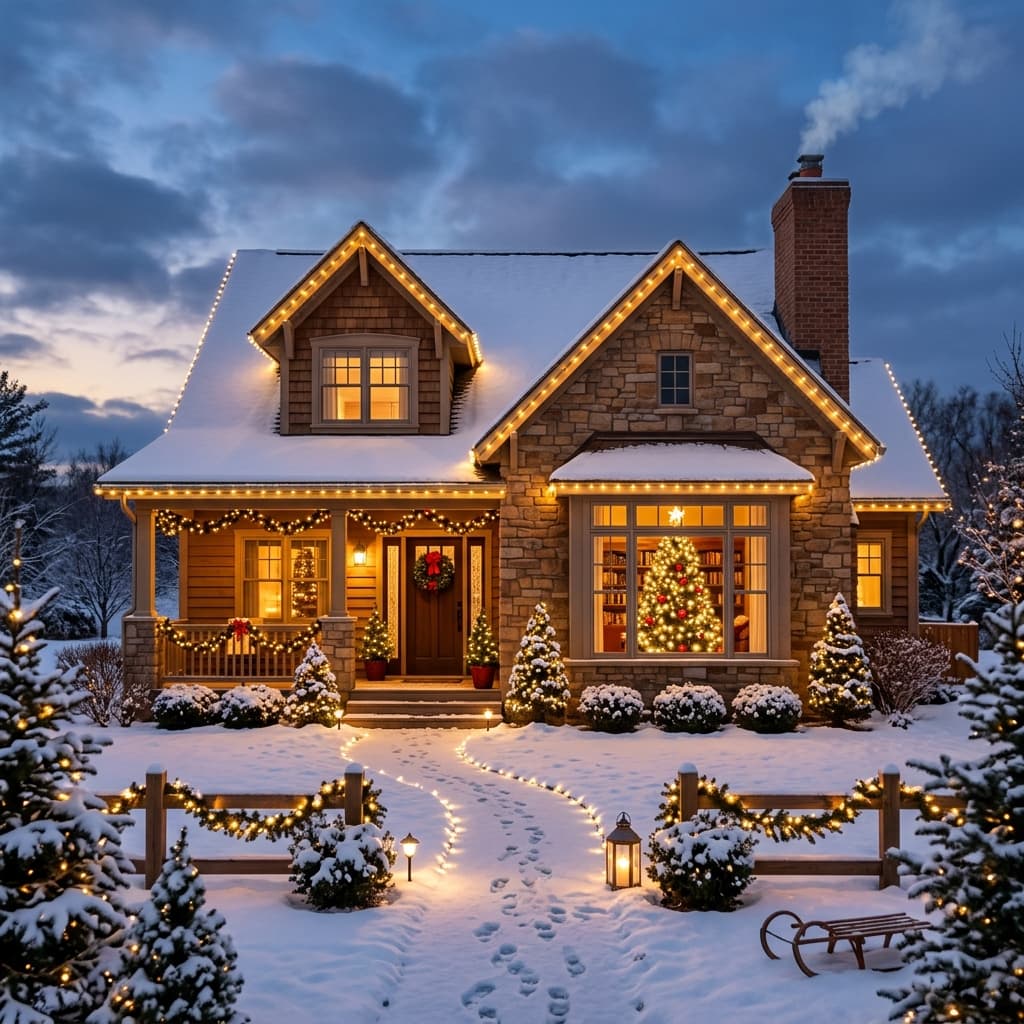
Modern holiday lighting transforms homes into warm, festive seasonal spaces.
What Do Christmas Lights Symbolize?
Christmas lights commonly symbolize **light in darkness, hope, joy, and celebration**. Historically, holiday lighting represents three main themes:
1. Light and Hope
Light has been used in many cultures to represent life and hope during the darkest part of the year. Evergreen and winter-light traditions existed long before modern electric Christmas lights, as communities celebrated the promise of returning warmth and daylight.
2. Christian Meaning
In Christian Christmas traditions, light represents Jesus as the "light of the world." Stars and glowing decorations can also remind people of the Star of Bethlehem, which guided the Magi to the Nativity. For many Christian families, decorating with lights is a reflection of this spiritual hope.
3. Family and Community Connection
Over the last century, Christmas lights have developed a strong social meaning. Families decorate together as a shared ritual. Neighbors display lights on their homes, and towns illuminate streets and public trees, creating a warm, shared aesthetic that brings people together.
Christmas Lights Began With Candles, Not Electricity
Before electric bulbs existed, families who decorated Christmas trees attached small **candles** to the branches. This practice became widely associated with German Christmas-tree traditions in the 17th and 18th centuries before spreading worldwide.
Candles created a beautiful, flickering effect, but they were exceptionally dangerous. A dry Christmas tree could easily catch fire from an open flame. Families had to keep buckets of water or sand nearby and would usually light the candles for only a few minutes on Christmas Eve.
🌲 What about Martin Luther?
A popular legend credits Protestant reformer Martin Luther with putting candles on a Christmas tree in the 16th century after seeing stars shining through evergreen branches on a winter walk. While this story is widely repeated, it should be presented as a traditional attribution rather than a firmly documented historical event.
Who Invented Electric Christmas Lights?
Edward H. Johnson is generally credited with creating the first electric Christmas-tree light string in 1882.
Johnson was a business associate of Thomas Edison and vice president of the Edison Electric Light Company. In 1882, he hand-wired **80 red, white, and blue electric bulbs** around his Christmas tree in New York City. The tree was also placed on a rotating stand, creating a spectacular display that drew reporters and onlookers.
Did Thomas Edison Invent Christmas Lights?
Not exactly. Edison developed the practical electric-light technology that made electric Christmas lighting possible. He also displayed strings of incandescent lights around his Menlo Park laboratory compound during the 1880 Christmas season. However, Johnson is the person who first applied this technology specifically to decorate a Christmas tree.
Pioneers of Holiday Lighting
To understand the history of Christmas lights, it is important to distinguish the roles of the key figures:
| Person / Entity | Key Contribution | Significance |
|---|---|---|
| Thomas Edison | Developed practical electric light bulbs & 1880 Menlo Park display | Laid the technological foundation for all electric holiday lighting. |
| Edward H. Johnson | Created the first electric Christmas-tree light display in 1882 | Introduced the concept of decorating trees with electric light strings. |
| President Grover Cleveland | Ordered the White House Christmas tree electrified in 1895 | Provided massive national publicity and sparked public interest. |
| General Electric | Introduced preassembled holiday light strings in 1903 | Simplified installation, moving lights away from custom electrical work. |
| Albert Sadacca & NOMA | Popularized affordable colored lights and formed the NOMA association | Turned Christmas lights into a mass-market, budget-friendly consumer custom. |
How Christmas Lights Became Popular in America
Electric Christmas lights did not become an instant household tradition. Early electric lighting was expensive, complicated, and required professional electrical work. Before commercially available preassembled sets, lighting a tree could cost the equivalent of thousands of dollars today, making it a luxury status symbol.
The White House Influence
President Grover Cleveland helped give electric Christmas trees additional public visibility when the White House Christmas tree was illuminated with colored electric lights in 1895. In 1923, President Calvin Coolidge presided over the lighting of the first National Christmas Tree, establishing a major public tradition.
Preassembled Sets Make it Accessible
General Electric began offering preassembled Christmas-light sets in the early 1900s. Instead of requiring a professional electrician to wire individual bulbs, consumers could buy ready-made strings.
Albert Sadacca and NOMA
Albert Sadacca helped make electric Christmas lights commercially popular. In 1917, as a teenager, he suggested that his family's novelty-lighting business sell colored lights to the public. He and his brothers later helped form the National Outfit Manufacturers Association (NOMA), which became the largest holiday lighting company in the world, driving down costs and making lights affordable for the average household.
When Did Christmas Lights Move From Trees to Houses?
During the early 20th century, Christmas lights gradually moved from indoor trees to outdoor homes, streets, and community spaces.
One of the most famous early examples is **Christmas Tree Lane in Altadena, California**, which began illuminating a street of majestic deodar cedar trees in 1920. In the 1920s and 1930s, community-wide displays and neighborhood competitions grew rapidly.
The iconic **Rockefeller Center Christmas Tree** in New York City first appeared in 1931 and was officially illuminated with lights in 1933, helping transform holiday lighting into a public, shared community spectacle.
From Candles to LEDs: The Technology Evolution
Holiday lighting has transitioned through several major technological stages, balancing safety, cost, and visual appeal:
- Candles (Before 1880): Beautiful but highly dangerous, requiring constant monitoring.
- Incandescent Bulbs (1880s–Present): The standard electric bulb, which produces a warm glow but generates heat and consumes substantial energy.
- Bubble Lights (1940s–1960s): Novelty bulbs filled with a low-boiling-point liquid that bubbles when heated, adding playful movement to trees.
- LED Lights (Late 20th Century–Present): Energy-efficient light-emitting diodes that use 80% to 90% less energy, generate minimal heat, and last far longer.
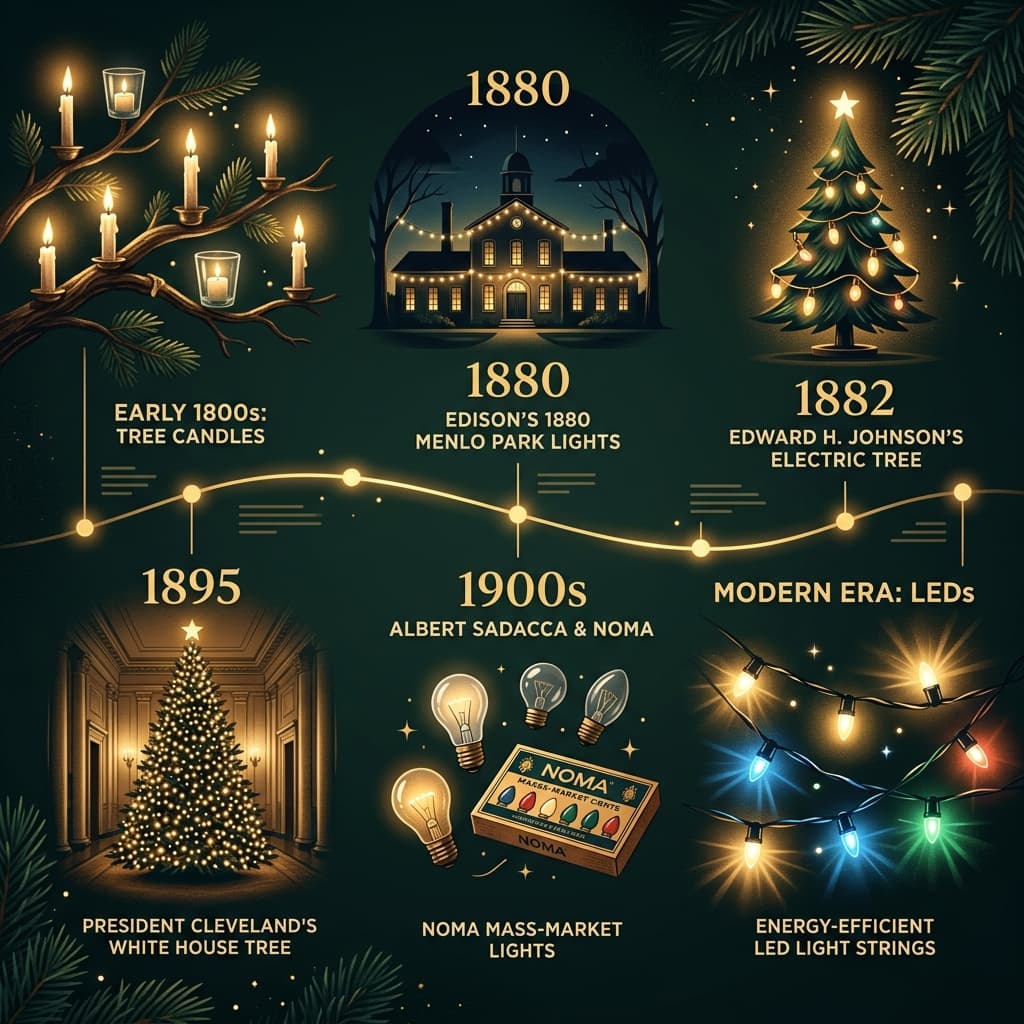
Timeline representing the major historical milestones of Christmas lighting.
Christmas Lights During World War II
The rapid growth of the holiday lighting industry was temporarily halted by World War II. Manufacturing of Christmas lights was suspended to conserve copper, rubber, and electricity for the war effort.
Blackout requirements were enforced in many coastal cities, especially on the West Coast, which meant outdoor holiday lights were prohibited. After the war ended, rising economic prosperity, mass suburban housing developments, and the return of manufacturing sparked a massive holiday decorating boom that established the classic American neighborhood display.
Did You Know?
💡 The 80-bulb start
Edward H. Johnson's first electric Christmas tree in 1882 used exactly 80 hand-wired red, white, and blue bulbs, and rotated on a custom-built pedestal.
💸 Luxury price tag
In the late 1890s, renting a Christmas light display with a professional installer could cost $300 (equivalent to several thousand dollars today).
⚡ Edison's 1880 laboratory
Thomas Edison was the first to hang outdoor electric light strings during the holidays, wrapping them around his Menlo Park lab compound.
🔋 LED energy efficiency
Modern LED holiday lights use up to 90% less energy than old incandescent light bulbs, dramatically lowering electric bills and fire hazards.
What We Know—and What Is Christmas-Lights Lore
Not every popular Christmas-lights story has the same level of historical evidence. For accuracy, it is important to distinguish documented history from traditional stories:
- Well-supported historical facts: Thomas Edison demonstrated electric lighting in 1880; Edward H. Johnson created the first electric Christmas tree in 1882; Grover Cleveland electrified the White House tree in 1895; General Electric sold preassembled light strings starting in 1903.
- Traditional attribution: The story connecting Martin Luther directly to the invention of Christmas tree candles is a traditional legend. While it represents a beautiful story, there are no historical documents from Luther's lifetime that verify this custom.
Frequently Asked Questions
Why do we put up Christmas lights?
We put up Christmas lights because they have become symbols of light, hope, celebration, and the Christmas season. The tradition developed from candle-lit Christmas trees and later evolved through electric lighting.
What is the meaning of Christmas lights?
Christmas lights can symbolize hope and light during the dark winter season. In Christian traditions, light can also represent Jesus and spiritual hope. Today, lights also have strong cultural and family meanings.
Who invented Christmas lights?
Edward H. Johnson is generally credited with creating the first electric Christmas-tree light display in 1882. Thomas Edison provided important electric-light technology, while Albert Sadacca later helped popularize Christmas lights commercially.
Did Thomas Edison invent Christmas tree lights?
No. Edison developed important practical electric-light technology and demonstrated electric lights in 1880, but Edward H. Johnson is credited with the first electric Christmas-tree display in 1882.
When did Christmas lights become popular?
Electric Christmas lights gradually became popular during the early 20th century. Preassembled sets, improved electrical systems and mass marketing helped make them more affordable. Their popularity expanded strongly during the 1920s and after World War II.
Why were candles originally used on Christmas trees?
Candles were used because electric lighting did not yet exist. They provided a way to illuminate the tree and became associated with the symbolism of light.
When did people start putting Christmas lights outside?
Outdoor Christmas lighting expanded in the United States during the early 20th century. Christmas Tree Lane in Altadena, California, began its lighting tradition in 1920, providing an important example of the move toward community outdoor displays.
Why do people put Christmas lights on their houses?
Outdoor lights allow families to extend Christmas decorating beyond the tree. They also create neighborhood displays and a shared sense of celebration.
Are Christmas lights a religious tradition?
They can be. Christian traditions give light religious meaning, but modern Christmas lights are also a secular cultural tradition enjoyed by many people for decoration, family activities and community celebrations.
Why are LED Christmas lights popular?
LED lights are popular because they are generally more energy-efficient, produce less heat and allow many modern colors and designs.
Why do people put Christmas lights up early?
There is no single universal date. People choose different times based on family traditions, local customs, personal preference and how long they want to enjoy their decorations.
Conclusion
We put up Christmas lights today because a centuries-old idea of celebrating with light evolved into one of the most recognizable holiday customs. The tradition progressed from candles to early electric bulbs, commercial light strings, outdoor displays, and today's programmable, energy-efficient LEDs.
By separating documented history from lore, we appreciate the distinct contributions of Edison, Johnson, Cleveland, and Sadacca. If you are decorating this Christmas, the lights on your tree are part of a much longer story that began long before anyone had to untangle a strand of bulbs.
Explore More Holiday Research Guides
Countdown Christmas covers the full spectrum of holiday origins, planning, and cultural traditions:
Discover who invented the first card in 1843 and how greeting cards became popular.
How a Central European tradition became a global symbol of the holiday season.
Explore the historical, religious, and Victorian origins of seasonal gift-giving.
Return to the live countdown calendar showing days until Christmas.
Clara Sterling
Holiday Editor & HistorianClara Sterling is a cultural historian and lifestyle writer specializing in Christmas traditions, holiday folklore, and winter solstice celebrations.