
Why Do We Decorate Christmas Trees? History, Meaning & Traditions
Discover the history and meaning behind Christmas tree decorations, including evergreen winter symbolism, ornaments, lights, stars, and modern traditions.
Christmas trees are one of the most familiar symbols of the holiday season, but the reason we decorate them is more interesting than it first appears. The tradition combines centuries of winter greenery customs with European Christmas traditions, religious symbolism, and family practices.
Today, people decorate trees for different reasons. For some families, the tree is deeply religious. For others, it represents tradition, celebration, memories, or simply the feeling that Christmas has arrived. The modern custom developed over time rather than coming from one single event or person.
We decorate Christmas trees because the tradition developed from the long use of evergreen plants during winter and later became part of European Christmas celebrations. Evergreens symbolized life and renewal during winter, while decorations such as candles, lights, ornaments, stars and angels later developed religious and cultural meanings. Today, many families also decorate trees to celebrate Christmas and continue family traditions.
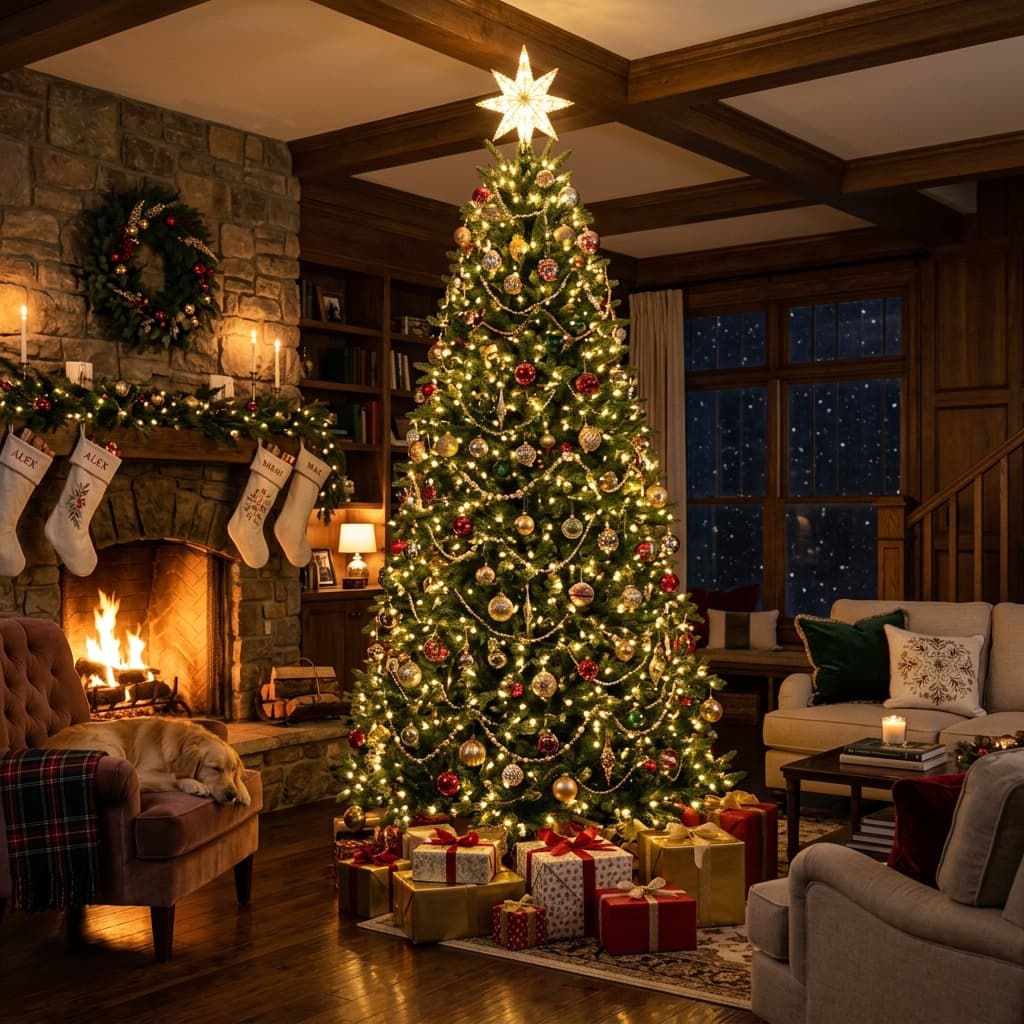
A classic decorated Christmas tree represents hope, celebration, and family connections.
Where Did the Tradition of Decorating Christmas Trees Begin?
Early Use of Evergreen Plants
Long before Christianity, evergreens carried special meaning during the winter solstice. In ancient Rome, Egypt, and Northern Europe, people hung evergreen boughs over their doors and windows. In the darkest days of winter, evergreens served as a reminder that green plants would grow again and that life would endure.
The Christmas Tree Tradition in Germany
The modern decorated Christmas tree developed in Germany during the 16th century. Devout Christians began bringing evergreen trees into their homes. If wood was scarce, families built pyramids of wood and decorated them with evergreens and candles. The tradition was closely tied to Christmas Eve celebrations, when the tree was revealed to children fully decorated.
Early Decorated Trees in Northern Europe
Historians document decorated trees in Riga, Latvia, as early as 1510, and in Reval (modern Tallinn, Estonia), in 1514, where local merchant guilds decorated trees in public squares. In the 16th century, records from the Alsace region (historically German-speaking, now part of France) describe citizens bringing evergreen firs indoors to decorate with paper roses, apples, wafers, and sweets.
Why Are Christmas Trees Evergreen?
Evergreen trees—such as firs, spruces, and pines—do not lose their leaves in winter. While other trees appear dead and bare, evergreens remain vibrant and green.
This natural characteristics made evergreens symbols of **eternal life, renewal, and hope**. Bringing them indoors during the winter solstice or Christmas season was a symbolic way to welcome life and vitality into the home during the coldest, darkest months.
Why Did People Start Putting Decorations on Christmas Trees?
The earliest decorations were simple, natural, and often edible. Families decorated trees with:
- Apples (The Paradise Tree): In medieval Europe, December 24 was celebrated as the Feast of Adam and Eve. Churches staged "Paradise Plays" featuring an evergreen tree hung with red apples to represent the Garden of Eden. When families brought trees into their homes, they hung red apples on the branches, linking back to this religious custom.
- Wafers and Sweets: Alongside apples, German families hung communion wafers, gingerbread, nuts, and sweets. Edible ornaments represented the abundance and sweetness of God's blessings.
- Paper Roses and Ribbons: Symbolized beauty, joy, and the blooming of life amidst winter snow.
What Do Christmas Tree Decorations Mean?
Over the centuries, the simple items hung on early trees evolved into standardized holiday decorations, each acquiring its own traditional meaning:
What Does the Star Mean?
The star placed on the top of the Christmas tree represents the **Star of Bethlehem**. According to the Christian Nativity story, this brilliant star guided the three Wise Men (Magi) to the birth of Jesus in Bethlehem, symbolizing divine guidance and hope.
What Does an Angel Mean?
An angel tree topper represents the **angels who announced the birth of Jesus**. In the Biblical Nativity, angels appeared to the shepherds in the fields to proclaim the good news. Putting an angel on top of the tree commemorates this spiritual message of peace and goodwill.
Why Are Candles and Lights Used?
Lights and candles symbolize **Christ as the Light of the World**, guiding believers through spiritual darkness. They also represent the warmth of winter fire and the returning sunshine after the winter solstice.
What Do Ornaments (Baubles) Represent?
Modern glass and plastic ornaments evolved directly from the red apples and round fruits hung on early German trees. Over time, German glassblowers in the 1840s began creating hollow glass spheres (called *Weihnachtskugeln* or baubles) to replace heavy fruit, representing the fruits of the spirit and seasonal joy.
Why Is Tinsel Used?
Tinsel was invented in Germany in the early 1600s, originally made from hammered silver. It was hung on trees to catch and reflect the light from candles. Traditional lore also links tinsel to the "Legend of the Christmas Spider," a story about spiders spinning webs on a tree that are miraculously turned into silver threads by Santa Claus or the Christ Child.
Why Are Red and Gold Decorations Popular?
Red represents the apples of the Paradise Tree and, in Christian theology, the blood of Jesus. Gold symbolizes royalty, light, and the gifts of gold brought by the Magi to baby Jesus.
Historical vs. Modern Tree Decorations
While we use a wide variety of decorations today, their origins are deeply rooted in simple natural items:
| Decoration | Historical Root / Early Form | Traditional Symbolism & Meaning |
|---|---|---|
| Evergreen Tree | Pine, Spruce, or Fir brought indoors | Eternal life, renewal, and winter hope. |
| Ornaments (Baubles) | Red apples (Paradise Tree wafers) | Fruits of the Earth; redemption from the Fall. |
| Twinkling Lights | Wax candles clipped to branches | Christ as the Light of the World; stars in the sky. |
| Star Topper | Handmade paper or straw stars | The Star of Bethlehem, guiding the Wise Men. |
| Angel Topper | Carved wooden figurines or dolls | The heavenly hosts announcing Christ's birth. |
| Tinsel | Hammered silver or tin foil strips | Reflecting light; winter icicles; the Christmas Spider. |
Why Do We Put Lights on Christmas Trees?
Putting lights on Christmas trees began with wax candles. German families attached candles using melted wax, pins, or wire clips. This created a beautiful illumination but posed a severe fire hazard, meaning candles were lit briefly and watched closely.
In 1882, **Edward H. Johnson** (vice president of the Edison Electric Light Company) hand-wired the first string of 80 electric Christmas tree lights. By 1903, General Electric sold preassembled light strings, which made electric lights safer and more convenient than candles. Read our guide on the history of Christmas lights to learn how this technology developed.
How Did Christmas Tree Decorating Spread to Britain and America?
The German custom of decorating Christmas trees spread to other countries through royal marriage and migration.
Queen Charlotte Introduces it to Britain
In 1800, German-born Queen Charlotte, wife of King George III, set up the first documented decorated Christmas tree in Britain at Queen's Lodge, Windsor. She decorated a yew tree for a party she threw for local children.
Victoria and Albert Make it Fashionable
In 1848, the *Illustrated London News* published an engraving of Queen Victoria, her German husband Prince Albert, and their children around a decorated Christmas tree at Windsor Castle. Victoria was highly popular, and British high society quickly adopted the custom. The engraving was reprinted in the United States in 1850 (with Victoria's crown and royal styling edited out to look like an American family), sparking a major Christmas-tree craze in America.
German Immigrants in America
German immigrants brought tree decorating to Pennsylvania and other regions in the late 18th and early 19th centuries. Initially, many conservative Americans viewed the tree as a foreign or pagan custom. However, the royal illustration and rising commercial production of ornaments in the late 19th century helped turn the Christmas tree into an essential American tradition.
Did Christmas Tree Decorating Come From Pagan Traditions?
The relation between Christmas trees and paganism is often misunderstood. It is too simplistic to claim the decorated Christmas tree comes directly from pagan traditions.
While pre-Christian Europeans used evergreen branches during winter solstice celebrations to symbolize life, the modern custom of bringing an entire decorated tree indoors developed much later within Christian European cultures (primarily German-speaking regions in the 1500s). The modern Christmas tree is an evolutionary tradition, blending ancient evergreen winter customs with Christian theology and secular family celebrations.
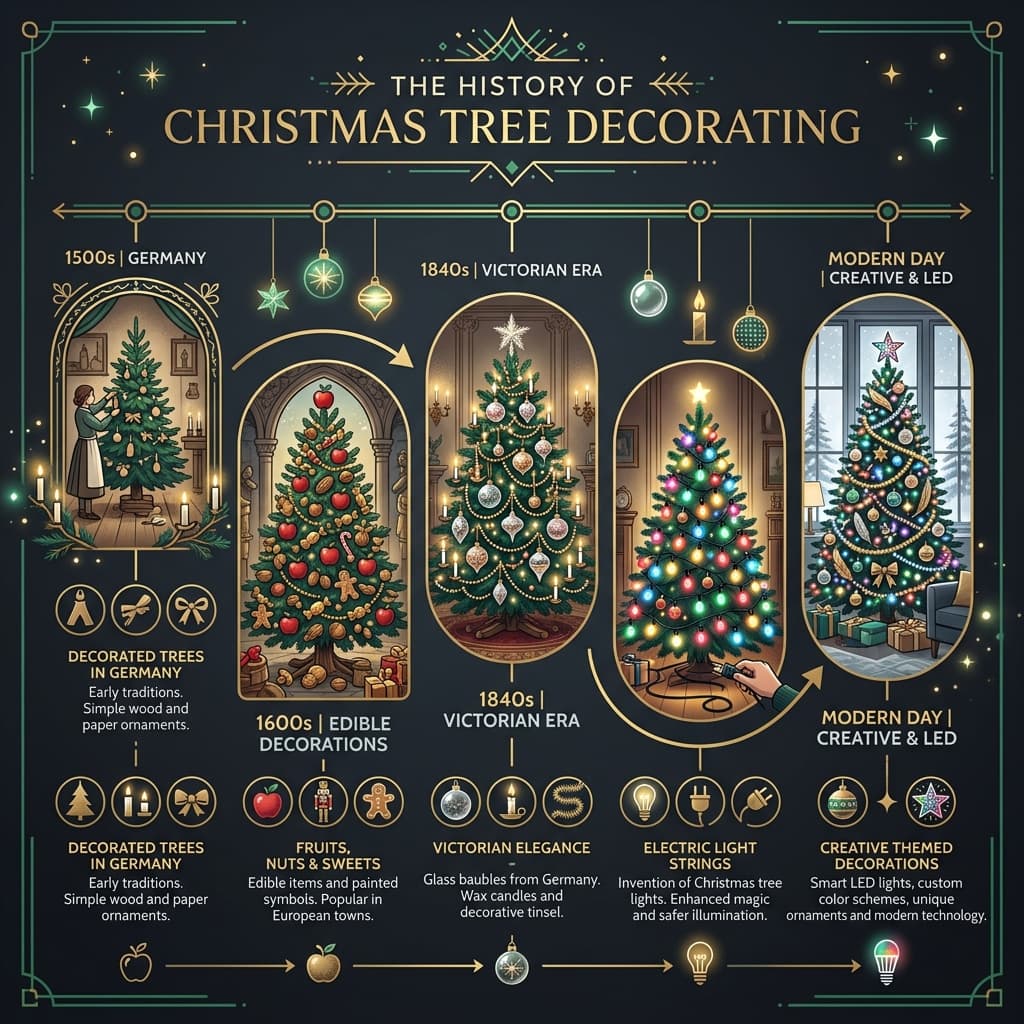
Timeline illustrating the major historical eras of Christmas tree decorating.
History of Tree Decorating Timeline
The evolution of the decorated Christmas tree over five centuries:
Documented Roots in Northern Europe
Guilds and communities in Germany, Latvia, and Estonia begin decorating communal evergreen trees with flowers and paper ornaments.
Early Edible Ornaments
German families bring trees indoors, decorating them with apples (recalling the Paradise Tree), nuts, gingerbread, and wafers.
Wax Candles Spread
Customs of placing small wax candles on tree branches emerge among wealthy German households, symbolizing light and warmth.
Queen Charlotte's Windsor Tree
German-born Queen Charlotte introduces the first documented decorated Christmas tree in Britain, setting a royal precedent.
The Victoria & Albert Popularization
A published illustration of Queen Victoria, Prince Albert, and their children around a decorated Christmas tree sparks a global trend.
Glass Baubles & American Adoption
German glassblowers create glass ornaments (baubles) for export. German immigrants popularize decorated trees in the United States.
First Electric Light Strings
General Electric releases preassembled Christmas light strings, slowly replacing hazardous candles with safe electric light.
The Modern Themed Tree
Trees combine family heirlooms, themed colors, LEDs, and personalized toppers, representing unique personal and cultural meanings.
Why Is There No Single "First Christmas Tree"?
Historically, there is no single date or individual who invented the decorated Christmas tree. Instead, several traditions developed at different times:
- Riga, Latvia (1510): A public guild tree was decorated with paper flowers and burned at the end of the winter festivities.
- Tallinn, Estonia (1514): Similar public guild trees are documented in historical guild records.
- German Alsace Region (1500s): Documented indoor trees decorated with apples, wafers, and paper.
- The Martin Luther Legend (1500s): A popular story credits Luther with adding candles to trees, but this is a traditional attribution rather than a documented event.
Therefore, the decorated Christmas tree is best understood as an **evolutionary tradition**, shaped by various cultures, regions, and innovations over many centuries.
Why Do Families Decorate Christmas Trees Today?
Today, decorating a tree is a highly valued tradition that transcends religious boundaries. Families decorate trees for several reasons:
- Shared Rituals and Memory: Unpacking ornaments from years past allows families to recall childhood memories, trips, and milestones.
- Warm Atmosphere: Twinkling lights and evergreen pine scents create a warm, cozy sanctuary during cold winter days.
- Secular Celebration: Public discussions show that many people who do not identify as religious still put up and decorate Christmas trees as a festive, cultural tradition to celebrate family and seasonal joy.
When Should You Decorate Your Christmas Tree?
There is no single correct date. Practices vary widely by family and culture:
- Late November: Many American families decorate the weekend immediately after Thanksgiving.
- Early December: The start of Advent is a traditional time for many Christian households.
- Christmas Eve (December 24): In Germany and parts of Eastern Europe, the tree is traditionally brought indoors and decorated on Christmas Eve.
Frequently Asked Questions
Why do we decorate Christmas trees?
We decorate Christmas trees because the tradition combines evergreen winter symbolism, European Christmas customs, religious meanings and modern family traditions.
When did people start decorating Christmas trees?
Decorated Christmas trees are documented in northern Europe in the 1500s. The National Christmas Tree Association records a decorated tree in Riga in 1510.
Why are Christmas trees evergreen?
Evergreens remain green through winter and have long been associated with life, renewal and hope during the cold season.
Why do we put lights on Christmas trees?
Early Christmas trees were sometimes decorated with candles. Modern electric lights developed later and became a safer, scalable way to illuminate trees.
Why do we put a star on top of a Christmas tree?
For many Christians, the star represents the Star of Bethlehem associated with the Nativity story.
Why do some people put an angel on top?
An angel can represent the angels associated with the birth of Jesus.
Did Christmas trees come from pagan traditions?
Evergreen plants were used in pre-Christian winter traditions, but the modern decorated Christmas tree developed later in European contexts. It is too simplistic to describe the modern Christmas tree as simply a pagan tradition.
Why do we put ornaments on Christmas trees?
Ornaments developed from early decorations such as fruit, nuts, sweets and candles. Modern ornaments can represent celebration, religion, family memories or personal taste.
When should you decorate your Christmas tree?
There is no universal date. Some families decorate in late November or early December, while others wait until closer to Christmas.
Why do families decorate Christmas trees?
Many families decorate because it creates a shared seasonal ritual and helps preserve family memories and traditions. Modern reasons can be religious, cultural, social or simply decorative.
Conclusion
We decorate Christmas trees today because a centuries-old custom of celebrating winter with evergreens merged with European Christmas customs and symbolic religious art. The apples and wafers of the Paradise plays transformed into glass baubles and paper roses, while candles paved the way for safe electric lights.
Whether your Christmas tree is topped with a star or an angel, and whether you decorate for spiritual reflection, family connections, or the pure joy of the seasonal atmosphere, you are participating in a rich, evolutionary tradition that has brought light and hope to dark winter nights for hundreds of years.
Explore More Holiday Research Guides
Countdown Christmas covers the full spectrum of holiday origins, planning, and cultural traditions:
Learn how Central European pine traditions spread internationally to become a global symbol.
From candles and Edward Johnson's 1882 rotating tree to energy-efficient modern LEDs.
Explore the historical, religious, and Victorian origins of seasonal gift-giving.
Return to the live countdown calendar showing days until Christmas.
Clara Sterling
Holiday Editor & HistorianClara Sterling is a cultural historian and lifestyle writer specializing in Christmas traditions, holiday folklore, and winter solstice celebrations.