
Who Was Saint Nicholas? The Real Story Behind Santa Claus
Explore the history of the 4th-century Mediterranean bishop whose reputation for secret generosity inspired European traditions and eventually created the modern Santa Claus.
Santa Claus is one of the most familiar figures of Christmas. But behind the red suit, sleigh, and presents is a much older story. Many of the traditions surrounding Santa can be traced, directly or indirectly, to Saint Nicholas of Myra, a Christian bishop remembered for generosity and charity.
The difficult part is separating the historical Nicholas from the legends that grew around him. Very few details of his life can be confirmed with certainty. Over many centuries, however, stories about his kindness spread across Europe and eventually helped shape Sinterklaas and the modern Santa Claus.
Saint Nicholas was a 4th-century Christian bishop associated with Myra in Lycia (modern-day Demre, Turkey). He became famous through traditions about secret generosity, charity, and protection of children and sailors. His December 6th feast day developed European gift-giving customs, which Dutch settlers brought to America as Sinterklaas, eventually evolving into Santa Claus.
Quick Facts About Saint Nicholas
| Fact | Historical Detail |
|---|---|
| Full name | Saint Nicholas of Myra |
| Also known as | Nicholas of Myra, Sint Nikolaas, Sinterklaas |
| Era | Fourth century (c. 280 – December 6, c. 343) |
| Region | Lycia, Asia Minor (eastern Mediterranean) |
| Modern country | Demre, Turkey |
| Role | Christian bishop of Myra |
| Feast day | December 6 |
| Famous for | Charity, secret gift-giving, and traditional miracles |
| Connection to Santa | Primary historical inspiration for modern Santa Claus |
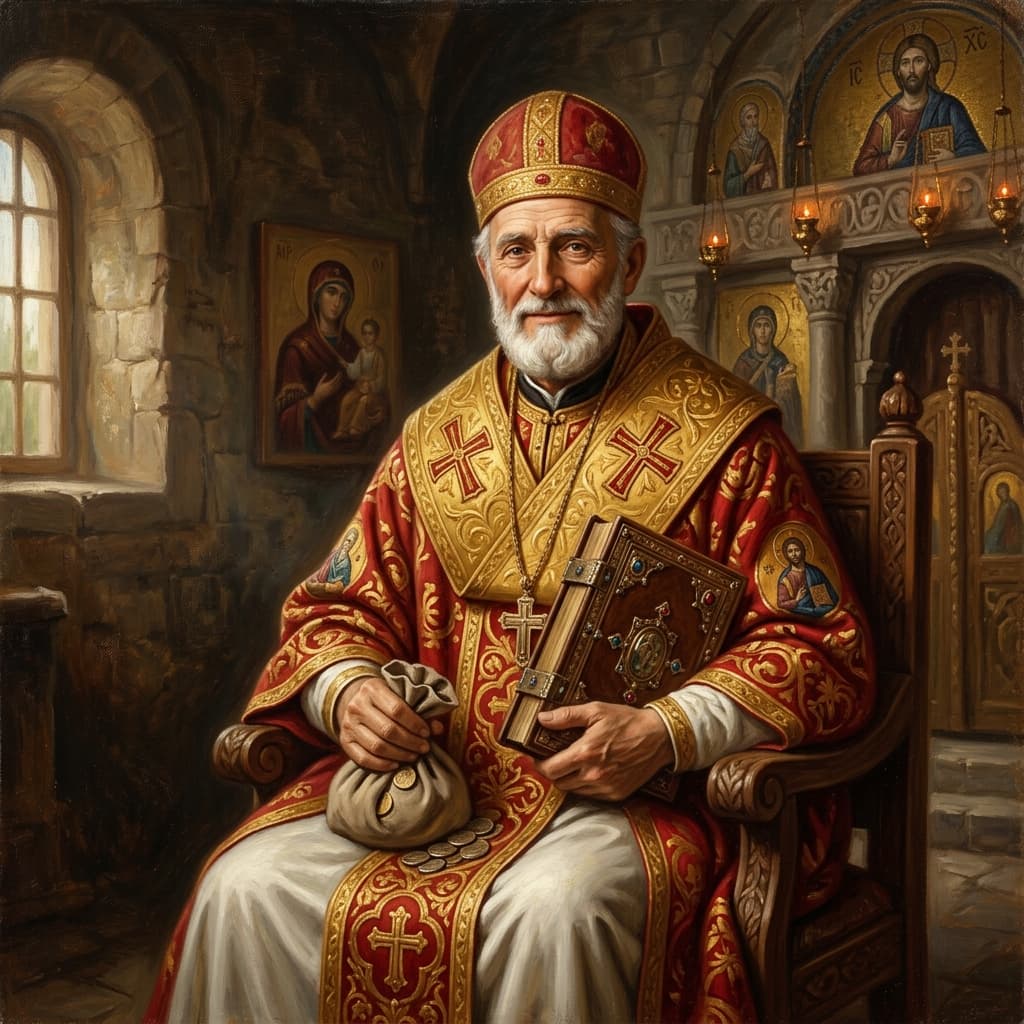
Historically grounded depiction of Saint Nicholas of Myra in Byzantine bishop robes and red mitre.
Was Saint Nicholas a Real Person?
Saint Nicholas is generally treated by historians as a real historical Christian bishop, but surviving contemporary 4th-century documentation is extremely limited.
Nicholas was not documented in the same way as a modern historical figure. There are no surviving writings penned by Nicholas himself. Instead, what we know comes from 5th- and 6th-century church histories, traditional hagiographies (lives of saints), and archaeological evidence.
What Historians Know
Nicholas served as Bishop of Myra in Lycia during the early 4th century. He was remembered across the Mediterranean for acts of courage, defense of early Christians, and extraordinary generosity.
What Remains Uncertain
Specific dates for his birth, precise details of his miracles, and claims that he attended the First Council of Nicaea in 325 AD belong to later medieval traditions rather than verified records.
Where Did Saint Nicholas Live?
Saint Nicholas lived in the ancient Roman province of Lycia in Asia Minor, located in modern-day southern Turkey.
Traditional accounts place his birth around A.D. 280 in Patara, a major Mediterranean port city. He later moved to nearby Myra, where he served as Christian bishop until his death around A.D. 343. Today, the Turkish city of Demre occupies the site of ancient Myra and houses the historical Church of St. Nicholas.
Key Geographic Insight:
The historical Saint Nicholas came from the warm, sunlit coasts of the Mediterranean—far removed from the snowy North Pole environment associated with modern Santa Claus!
What Was Saint Nicholas Known For?
Saint Nicholas became famous for extraordinary generosity, particularly stories about secretly helping poor families and protecting children and sailors.
The most famous story tells of a poor father who could not afford dowries for his three daughters. Learning of their plight, Nicholas visited the family's house secretly at night and tossed bags of gold coins through an open window (or down the chimney), landing inside stockings or shoes left by the fire to dry.
This story established three fundamental concepts that still define holiday gift-giving today:
- Anonymous giving: Helping others quietly without seeking personal fame.
- Nighttime visits: Delivering gifts secretly while families sleep.
- Stockings & Shoes: Leaving gifts inside footwear left near the hearth.
For a deeper exploration of gift origins, read our detailed article on why we give gifts at Christmas.
Why Is Saint Nicholas Day Celebrated on December 6?
Saint Nicholas Day is celebrated on December 6 because church tradition records December 6, A.D. 343, as the date of his death.
In Christian tradition, a saint's feast day is observed on the date of their passage into eternal life. Across Central and Western Europe, December 6th (and St. Nicholas Eve on December 5th) remains a major gift-giving celebration for children.
Saint Nicholas Day vs. Christmas Day
| Feature | Saint Nicholas Day (Dec 6) | Christmas Day (Dec 25) |
|---|---|---|
| Date celebrated | December 6 | December 25 |
| Historical entity | Connected to Saint Nicholas | Celebrates the birth of Jesus Christ |
| Gift tradition | Small treats in shoes/stockings | Main holiday gift-giving |
| Geographic focus | Strong in Central & Western Europe | Global holiday tradition |
| Primary figure | Saint Nicholas / Sinterklaas | Santa Claus (in U.S./popular culture) |
How Did Saint Nicholas Become Sinterklaas?
During the Middle Ages, Saint Nicholas traditions spread across Europe. In the Netherlands, Sint Nikolaas evolved into the beloved figure Sinterklaas.
Even after the 16th-century Protestant Reformation discouraged the veneration of saints, Dutch communities preserved Sinterklaas. He was depicted as an elderly, dignified bishop with a long white beard, red cape, and mitre, riding a white horse over rooftops to deliver treats into children's shoes.
When Dutch settlers established New Amsterdam (modern New York) in the 17th century, they brought Sinterklaas customs to North America. The English-speaking population gradually mispronounced Sinterklaas into Santa Claus.
How Did Sinterklaas Become Santa Claus in America?
Santa Claus transformed into a uniquely American figure during the 19th century through the work of three key New York figures:
1. Washington Irving (1809)
In his satirical History of New-York, Irving depicted Saint Nicholas as a jolly, pipe-smoking Dutch figure riding over rooftops in a flying wagon, shifting the character from a solemn bishop into folklore.
2. Clement Clarke Moore (1823)
The poem “A Visit from St. Nicholas” (“The Night Before Christmas”) defined Santa's arrival on Christmas Eve in a sleigh pulled by eight named flying reindeer, entering through the chimney.
3. Thomas Nast (1860s–1880s)
Illustrator Thomas Nast created annual Santa drawings for Harper's Weekly, standardizing the red suit, white beard, toy workshop, naughty/nice list, and North Pole home.
For a complete deep-dive into this 19th-century visual transformation, explore our guide on the history of Santa Claus.
Saint Nicholas vs. Santa Claus: Key Differences
Although connected, the historical bishop and the modern folklore character are distinct entities:
| Feature | Saint Nicholas | Santa Claus |
|---|---|---|
| Identity | Historical Christian bishop | Modern cultural folklore character |
| Primary Role | Church leader and charitable donor | Toy deliverer and Christmas icon |
| Home / Origin | Myra, Asia Minor (modern Turkey) | Traditionally lives at the North Pole |
| Historical Era | 4th century (Late Roman Empire) | Developed mainly in 19th–20th century America |
| Primary Date | Feast Day: December 6 | Christmas Eve (December 24) |
| Traditional Clothing | Red & gold bishop vestments & mitre | Red suit trimmed with white fur & boots |
| Transportation | White horse or walking | Sleigh drawn by flying reindeer |
Saint Nicholas: Historical Fact vs. Legend
This matrix clarifies what historians consider documented historical evidence versus later folklore:
| Claim / Story | Confidence Level | Historical Assessment |
|---|---|---|
| Nicholas lived in Asia Minor (Turkey) | Historical Fact | Strong consensus from early historical records and church traditions. |
| Nicholas was bishop of Myra | Historical Tradition | Strongly supported by 5th-century historical sources and church lists. |
| Nicholas was known for generosity | Strong Tradition | Universal theme across all early hagiographies and folklore. |
| Nicholas secretly gave three gold bags | Famous Legend | Popular traditional story explaining dowry assistance for three sisters. |
| Nicholas saved sailors in a storm | Traditional Miracle | Maritime tradition making him patron saint of sailors. |
| Nicholas attended Council of Nicaea | Debated Tradition | Claimed in later medieval church tradition; omitted in earliest lists. |
| Nicholas flew through the sky | Santa Folklore | 19th-century American literary creation (Washington Irving & Moore). |
| Nicholas lived at the North Pole | Modern Legend | 19th-century illustration tradition started by Thomas Nast. |
| Coca-Cola created Santa's red suit | False Myth | Debunked — Red-suited Santa was common decades before 1931. |
Where Are Saint Nicholas's Relics Today?
The remains of Saint Nicholas have a fascinating historical journey spanning Turkey, Italy, and modern scientific analysis.
Nicholas was originally buried in his cathedral church in Myra. In A.D. 1087, during political instability in the region, Italian merchants transported the majority of his bones to Bari, Italy, where the Basilica di San Nicola was constructed to house them. Another portion of relics was brought to Venice.
In recent years, Oxford University radiocarbon testing of bone fragments confirmed that the relics date to the 4th century, matching the historical era of Saint Nicholas. In 2017, Turkish archaeologists also discovered an intact mosaic floor and tomb beneath the St. Nicholas Church in Demre, Turkey.
Saint Nicholas Timeline: 4th Century to Today
| Period | Historical Milestone |
|---|---|
| c. 280 AD | Nicholas is born in Patara, a port city in ancient Lycia (modern Turkey). |
| c. 300–343 AD | Nicholas serves as Bishop of Myra, becoming famous for charitable acts during Roman rule. |
| Dec 6, c. 343 AD | Nicholas dies in Myra; December 6 becomes established as his feast day. |
| Middle Ages | Cult of St. Nicholas spreads through Byzantine Empire and across Western Europe. |
| 1087 AD | Nicholas's relics are relocated from Myra to Bari, Italy, establishing a major pilgrimage site. |
| 1500s | Dutch communities maintain 'Sinterklaas' customs despite Protestant Reformation changes. |
| 1770s | Dutch settlers bring Sinterklaas traditions to New York; early U.S. print references appear. |
| 1809 | Washington Irving popularizes a whimsical Dutch St. Nicholas in his History of New-York. |
| 1823 | A Visit from St. Nicholas ('The Night Before Christmas') introduces sleigh, 8 reindeer, and Dec 24 delivery. |
| 1860s–1880s | Thomas Nast illustrates Santa for Harper's Weekly, adding North Pole, workshop, and beard. |
| 1931 onward | Haddon Sundblom's Coca-Cola ads standardize the warm, red-suited Santa image globally. |
| Today | St. Nicholas remains an important saint, while Santa Claus is a global holiday icon. |
Frequently Asked Questions About Saint Nicholas
Was Saint Nicholas a real person?
Yes. Saint Nicholas is generally understood as a historical 4th-century Christian bishop associated with Myra in Lycia (modern Turkey). However, many stories told about him come from later medieval traditions.
Is Saint Nicholas the same as Santa Claus?
No. Saint Nicholas was a historical Christian bishop. Santa Claus is a later cultural character whose development was inspired by Saint Nicholas, Dutch Sinterklaas traditions, and 19th-century American literature.
Where was Saint Nicholas born?
Traditional accounts place his birth around A.D. 280 in Patara, an ancient Mediterranean port city in Lycia (modern-day Turkey).
Where did Saint Nicholas live?
He served as Bishop of Myra, an ancient city in Lycia. Modern Demre in Turkey occupies the site of ancient Myra.
When is Saint Nicholas Day?
Saint Nicholas Day is traditionally celebrated on December 6.
Why is Saint Nicholas associated with gifts?
Stories describe Nicholas secretly helping poor families with money and charity. The famous story of three gold bags tossed into stockings became particularly influential in linking him with gift-giving.
What is Sinterklaas?
Sinterklaas is the Dutch form of Saint Nicholas and an important European gift-giving figure that Dutch settlers brought to America, eventually evolving into Santa Claus.
Did Saint Nicholas live at the North Pole?
No. The historical Saint Nicholas lived in the Mediterranean region of Asia Minor. The North Pole is part of the 19th-century American Santa Claus folklore.
Did Coca-Cola create Santa Claus?
No. Red-suited Santa Claus illustrations existed decades before Coca-Cola's 1931 advertising campaign. Coca-Cola popularized a warm grandfatherly image, but did not create Santa.
What can Saint Nicholas teach us about Christmas?
Saint Nicholas reminds us that true holiday gift-giving is centered around quiet generosity, anonymous charity, and helping those in need—rather than commercialization.
Conclusion: The True Legacy of Saint Nicholas
Saint Nicholas was not the red-suited man of modern Christmas movies. He was a 4th-century Mediterranean bishop remembered for courageous faith and quiet, anonymous generosity.
The journey from Saint Nicholas of Myra to modern Santa Claus took nearly two millennia. European customs, Dutch Sinterklaas, Washington Irving, Clement Clarke Moore, Thomas Nast, and modern culture each added layers to the story. Understanding that history reveals how a spirit of selfless giving can cross centuries and inspire generations around the world.
Explore Related Christmas History Guides
Continue exploring holiday origins, traditions, and research guides:
Explore how 19th-century American poets and illustrators shaped modern Santa.
The fascinating origin of Santa's famous laugh and catchphrase.
The biblical, historical, and cultural reasons behind holiday gift traditions.
Discover Sinterklaas, Père Noël, La Befana, and unique global customs.
From evergreen boughs in pagan winter to Renaissance German traditions.
Understanding the spiritual season of preparation leading up to Christmas.
The comprehensive timeline of midwinter festivals and December 25 origins.
Clara Sterling
Holiday Editor & HistorianClara Sterling is a cultural historian and lifestyle writer specializing in Christmas traditions, holiday folklore, and winter solstice celebrations.